Oceanic rogue waves
led by Maura Brunetti, Debbie Eeltink and Jérôme Kasparian
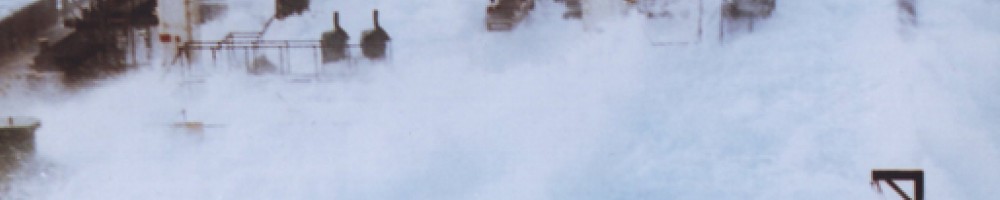
Rogue waves are transient giant waves, exceeding twice the significant wave height. As described in [1] they `appear from nowhere and disappear without a trace’.
The mechanism at the root of the formation of rogue waves is still unclear. They are attributed to non-linearity and/or to the interference of fluctuating individual waves of smaller amplitude. We work both numerically and experimentally to improve this understanding, especially in the presence of wind [2-3], using deterministic or statistical approaches. Analogies with corresponding optical nonlinear devices are also investigated.
We are currently installing instruments to monitor wind waves and their breaking on Lake Geneva, using the LéXPLORE floating platform (WIND2WAVES project). This site is ideally suited since it offers an intermediate scale of several tens of km, between wave flumes where wave development is incomplete and ocean conditions where the long fetch leads to the onset of swells. The measurements will rely on stereoimaging to determine the directional spectrum of the waves, as well as near-infrared thermal imaging to detect wave breaking and infer the associated energy dissipation. They will allow us (i) to characterize the statistics of young wind waves and their deviation from Miles-mechanism growth rates, and (ii) to train and validate a hybrid two-dimensional nonlinear Schrödinger model incorporating wind forcing and a neural-network parameterisation of wave breaking, the first model of its kind for this regime.
[1] Akhmediev, Ankiewicz, Taki, Phys. Lett. A 373, 675 (2009) https://doi.org/10.1016/j.physleta.2008.12.036
[2] Brunetti et al., Phys. Lett. A 378, 1025 (2014) https://doi.org/10.1016/j.physleta.2014.02.004
[3] Eeltink et al., Phys. Fluids 29, 107103 (2017) https://doi.org/10.1063/1.4993972