Reducing dinitrogen to ammonia
As the only known metalloenzyme capable of reducing kinetically inert dinitrogen (to produce ammonia), nitrogenase is of significant research interest. First, understanding how nitrogenase transfers electrons and hydrolyzes ATP to reduce dinitrogen (in aqueous solution) could assist the design of bio-inspired catalysts for ammonia production. The decoupling of nitrogenase from its necessity to hydrolyze ATP represents an additional valuable target.
In 2016, it was shown that an electrode could be used to bypass the electron-supplying, ATP-hydrolyzing Fe protein of nitrogenase and supply electrons to the catalytic MoFe protein for substrate reduction. To this end, one of the aims of our research group is to develop advanced nitrogenase–electrode interfaces to study this enzyme’s mechanism, ultimately progressing towards the deployment of nitrogenase in new biotechnologies for ammonia production. Take a look at this review of our earlier work.
More recently, we’ve been investigating cooperativity in nitrogenase. The MoFe protein is an (αβ)2 heterotetramer of approximately C2 symmetry with two functional catalytic halves undergoing repeated transient association with the Fe protein for successive electron delivery to the FeMoco. Why is the MoFe protein a dimer of dimers? Is this simply for increased stability and solubility of the protein? Not only — cooperativity has been observed between the two αβ halves of the MoFe protein.
Our recent research has investigated this cooperativity by (i) introducing a steric inhibitor of the Fe protein to one αβ half of the MoFe protein, and (ii) disrupting a highly conserved mononuclear metal-binding site of Mo-dependent nitrogenases, which we speculated may have been involved in transducing conformational cooperativity.
Co-funded by a multi-PI lead agency grant between Switzerland, France and Germany, with George Cutsail, Wenyu Gu, Victor Mougel, Markus Reiher and Tristan Wagner (SNSF Grant 10001903, 2025–2029).
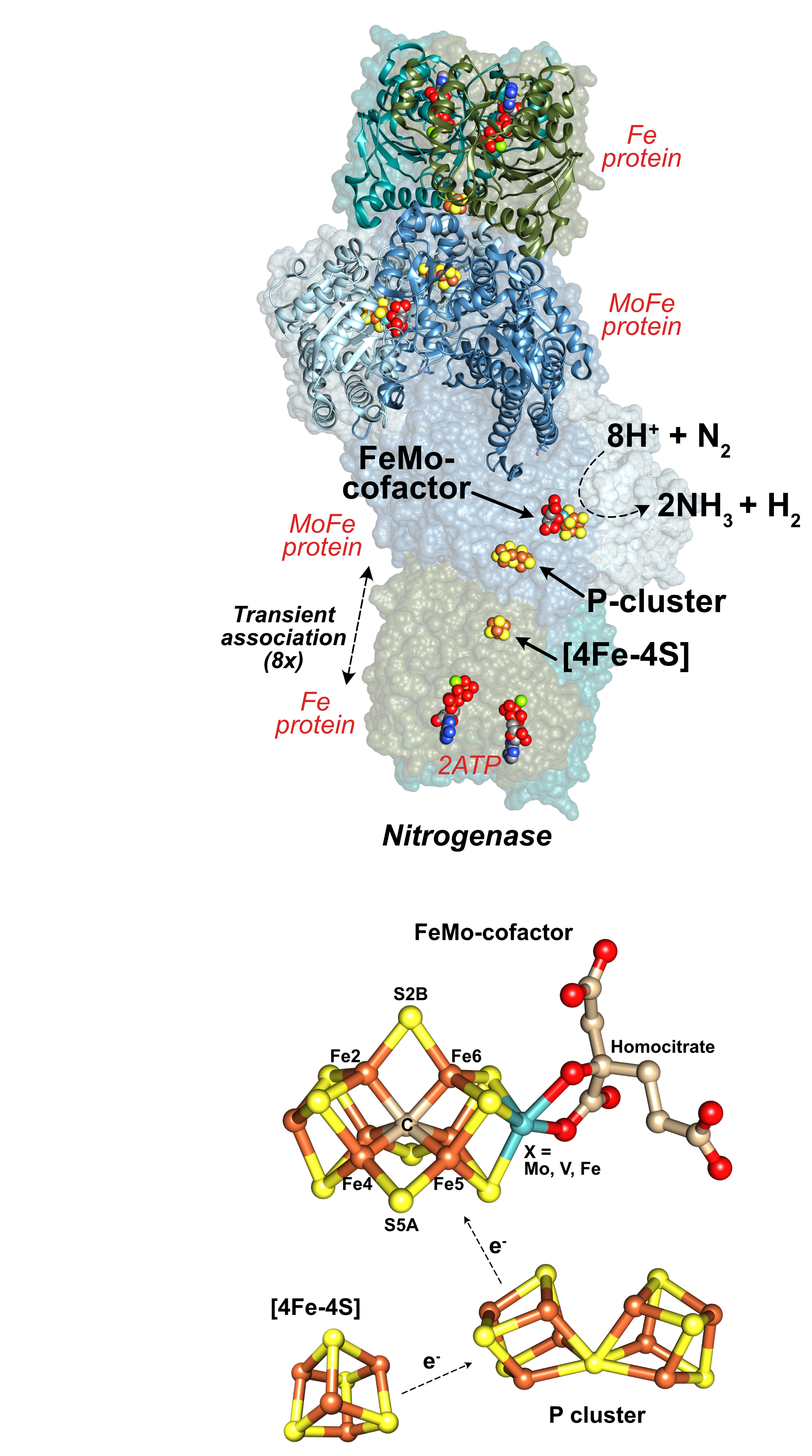
Bottom. Structures of nitrogenase’s cofactors, where the position colored in cyan can be a Mo, V, or Fe metal. Fe = rust, S = yellow, C = beige, Mo/V/Fe = cyan, O = red.
Dark-operative protochlorophyllide oxidoreductase
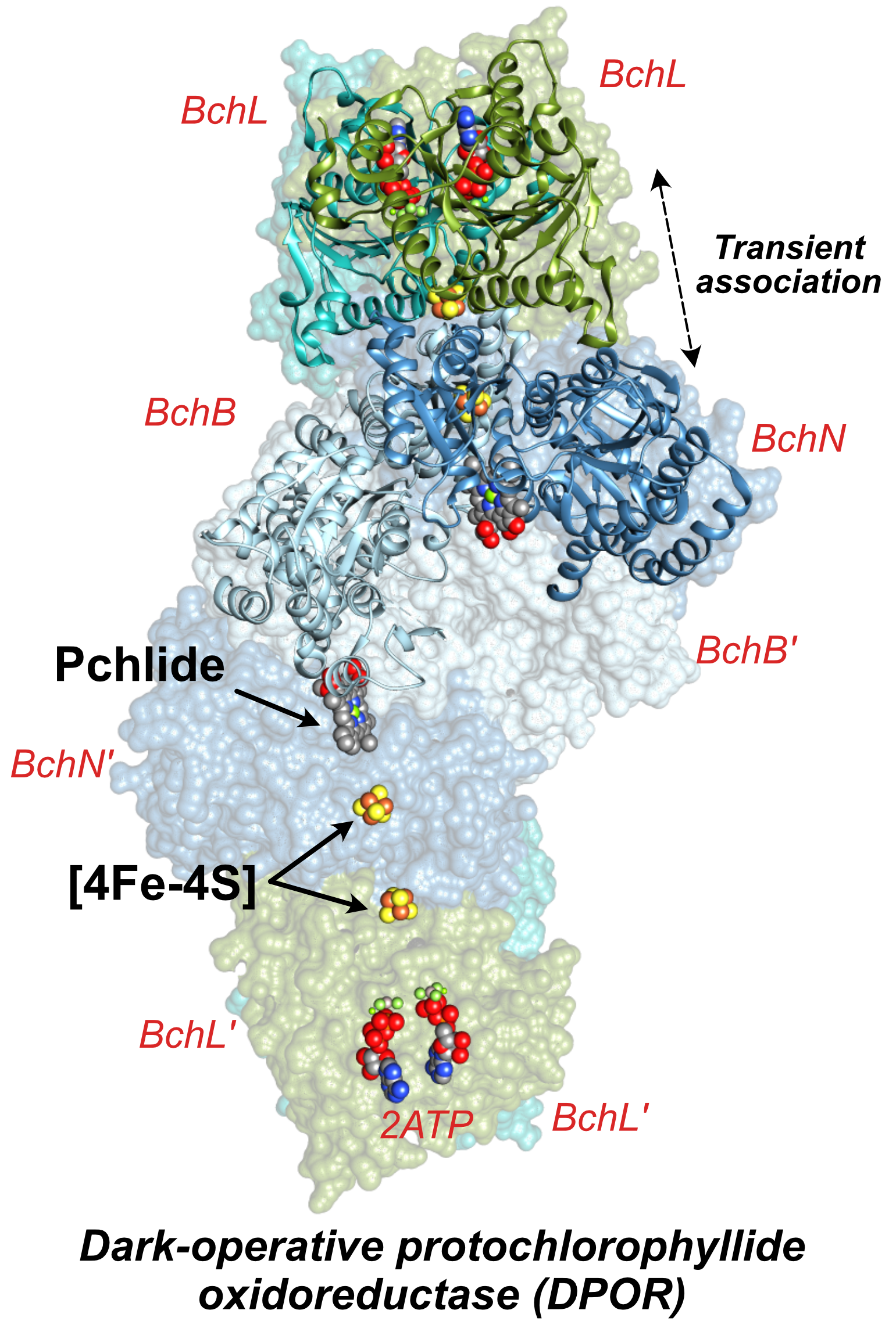
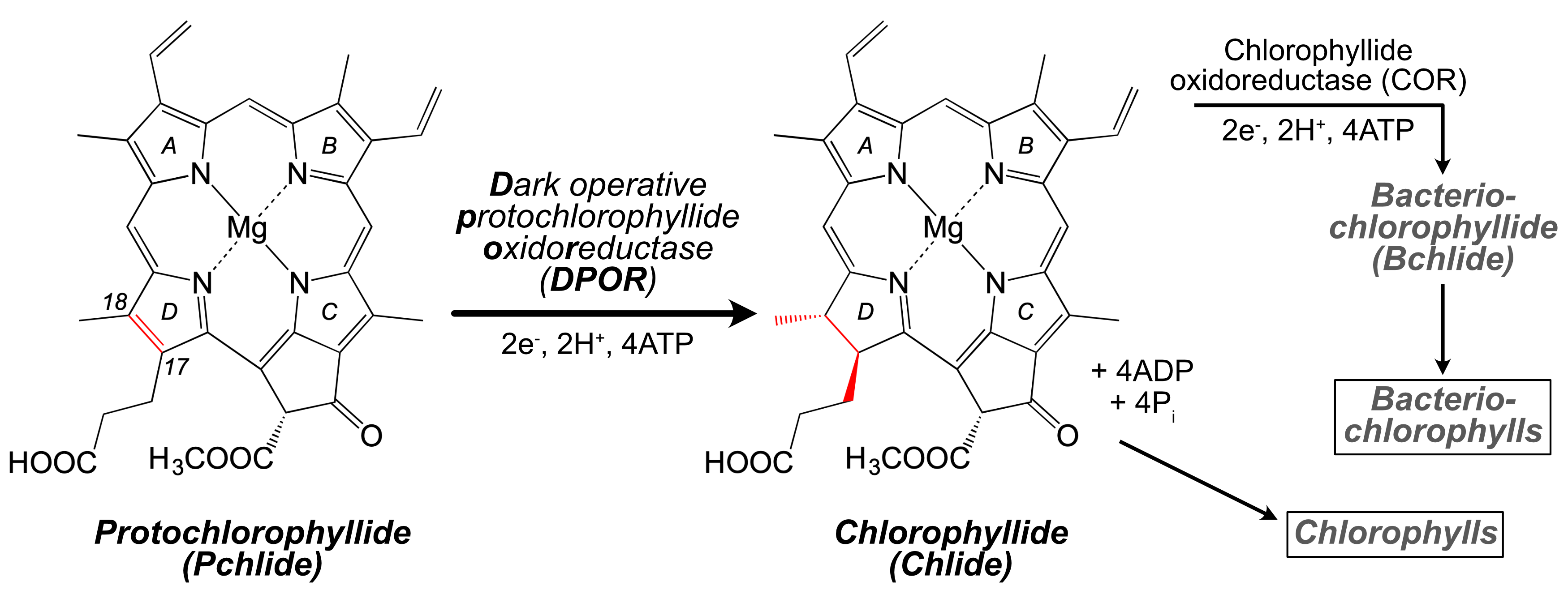
Chlorophylls and bacteriochlorophylls are organic pigments that are essential to light-harvesting organisms, produced in nature on a global scale of around 6 billion tons annually. DPOR is a complex metalloenzyme that catalyzes the light-independent 2-electron reduction of protochlorophyllide (Pchlide) to chlorophyllide (Chlide) in phototrophic bacteria, which undergoes a second 2-electron reduction to yield bacteriochlorophyllide (Bchlide).
We are interested in understanding the catalytic and electron transfer mechanisms of this metalloenzyme complex, which shares a degree of homology with nitrogenase. DPOR also couples the hydrolysis of ATP to electron transfer for substrate reduction.
We have reported electron donors that are able to sustain in vitro catalytic turnover of DPOR, as alternatives to the commonly used dithionite anion.
Supported by the Swiss National Science Foundation, grant number 200021_191985 (2020–2024).
Making and splitting hydrogen
Hydrogenases are metal-containing enzymes that reduce protons to produce molecular hydrogen (H2, or vice versa). Thus, hydrogenases are attractive for new biotechnologies to either produce electrical energy from the oxidation of H2, or to produce H2 from renewable electrical energy (as a form of energy storage).
In our research group, we typically employ hydrogenase as a model hydrogen-evolving metalloenzyme when we are developing electron mediators and/or tailored electrode surfaces for enzymatic electrochemistry. While there are 4 main types of hydrogenases ([NiFe], [NiFeSe], [FeFe] and [Fe]-only), we primarily employ the [FeFe]-hydrogenase from Clostridium pasteurianum.
More recently, we have reported on direct electron transfer to [FeFe]-hydrogenase using easy-to-make mesoporous indium:tin oxide (ITO) electrodes. We observed high catalytic activity and prolonged stability. We hypothesize that this is due to the nanoconfinement effect, where [FeFe]-hydrogenase was found to be comparatively more active and more stable on mesoporous vs. planar electrodes.
Supported by Swiss National Science Foundation project funding (Grant 10001704, 2024–2028).
![Representation of [FeFe]-hydrogenase from Clostridium pasteurianum](https://www.unige.ch/sciences/chiam/milton/application/files/3017/4064/9446/Figure_1_V2.png)
Reducing carbon dioxide to formate
Formate dehydrogenases are enzymes that catalyze the reduction of carbon dioxide to formate (or formate oxidation to carbon dioxide). Fdhs can be further divided into metal-dependent Fdhs (W- or Mo-dependent) and metal-independent Fdhs (such as NAD+-dependent).
We are interested in metal-dependent Fdhs as they can undergo facile electron transfer with heterogeneous surfaces (such as electrode surfaces) and catalyze carbon dioxide reduction at high rates. To this end, we are interested in developing bespoke and tailored electrode:enzyme interfaces for enhanced electroenzymatic carbon dioxide reduction by Fdhs.
Selmihan Sahin in our group was awarded a Marie Skłodowska-Curie Individual Fellowship concerning metal-dependent Fdh electrochemistry — see BERCO2.
Financial support
Our research receives continuous financial support from the NCCR Catalysis in Switzerland (since 2021), a National Centre of Competence in Research (Grants 180544 and 225147). Support for individual projects is noted in each section above.