


Iconophobia of iconodules
Béatrice Joyeux-Prunel
Let's face it: disciplinary and symbolic barriers have prevented the humanities from confronting the deluge of images.
Despite the traditional mistrust of philosophers towards images, from the time of engravings and then printing, the role of technology in the production and circulation of images has complicated their apprehension by the humanities. With the printing press and photography, it was henceforth possible to reproduce visuals ad infinitum, which shook the certainties of aesthetics: the idea that an original work made by human hands is stronger and more beautiful than a copy no longer made sense; the contribution of the artist's intelligence, the richness of his or her point of view and the price of his or her talent no longer seemed to make a difference.
Terrible transition to the multiple...
The issue of the reproduction of images raises the question of their uniqueness and meaning. The construction of the artistic value of a work, along with its economic value, has long required that the work be a unique object, the embodiment of an artist's vision. This concept is threatened by the very nature of photography. When the multitude takes over, the uniqueness of the work of art loses its identity; the image, to which the work is now reduced, is dispersed in the ocean of possibilities. In this multitude, how is it possible to grasp the intangible value of the artist's work? How can the excellence of the visual richness of a single image be recognized, if a new medium can create and disseminate a similar richness by simply mirroring it?
Walter Benjamin brilliantly illustrated this phenomenon in the 1930s: works of art, by becoming infinitely reproducible, lose their aura.[1] Let's imagine what a European in Benjamin's time might have experienced: you no longer had to go to the Louvre to see the Mona Lisa, since it was now available in illustrated magazines, postcards, or low-quality reproductions. On the day one went to the Louvre, what impact did the 'real' Mona Lisa have? A human tide prevented it from being seen, the lighting was poor, the size of the work was not that imposing after all... Even today, in the noise that surrounds this masterpiece, to approach it aesthetically is challenging if not impossible.

"The "Mona Lisa" has been found in Florence". Excelsior: daily illustrated newspaper: news, literature, science, arts, sports, theatre, elegance, Paris, 13 December 1913.
Image specialists perhaps dismiss the flood of images especially because they believe in the power of the individual image. But this iconophobia of iconodules is also grounded in political considerations.
Political uses of images
The ubiquity of images does not only complicate our understanding of the works. This new status has also given rise to new uses of the image, more effective because reproducibility is possible at an unprecedented speed. The image is indeed a potent weapon, especially when it can be circulated in quantity. This was already an issue in the iconoclastic quarrels under the Byzantine Empire.[2] When a political actor has access to a great quantity of images, he gains a dangerous power of conviction. Nazi propaganda made the problem even more relevant. Walter Benjamin himself witnessed this change in Germany in the 1930s.
Images and the culture industry
It was in this perspective that the so-called Frankfurt School philosophers, Theodor Adorno and Max Horkheimer, deepened their post-war critique of what they called "the culture industry."[3] These two masterminds of the book civilisation were able to correspond with their students in Latin. Fleeing Nazism to the United States in the 1940s, they found themselves teaching young people who had been force-fed illustrated magazines, comic books and films, and who were eager to talk confidently about things they had not read in depth. Adorno and Horkheimer found again what they had fled from, only more insidiously: misleading advertisements, generalized inculture, the failure of critical thinking, the witch hunt, the political asthenia of a nation. The culture industry soon became for them the Number One Enemy: a danger to democracy as well as to individual freedom and inner life.
This position grew deeper in the 1960s in European intellectual and artistic circles; and the humanities still live in this legacy.
The visual flow of the press and television fed the critique of the contemporary economic and media system by Situationist artists and writers from the late 1950s. The "Situs" waged war on capitalism and its capacity to maintain an incessant but objectless desire with the image.
--
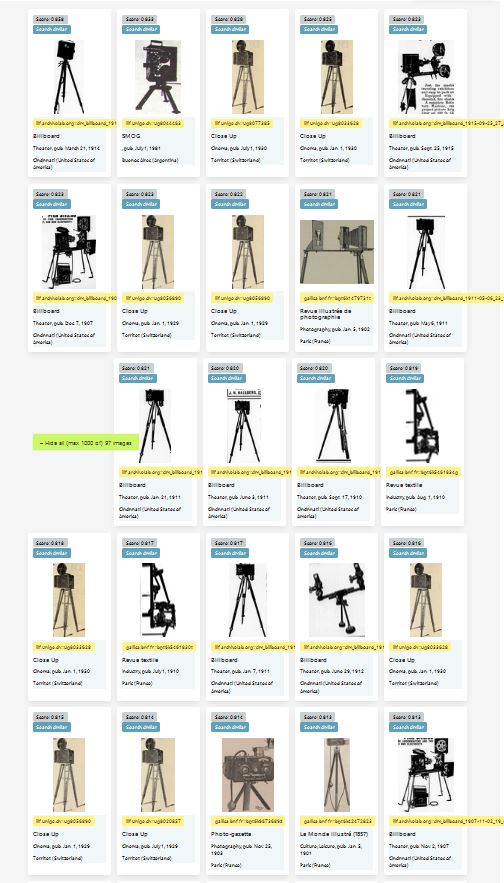
Illustration: Results of a search for camera images from the turn of the 1930s, on the corpus of illustrated journals of the Visual Contagions project (research platform: https://visualcontagions.unige.ch/explore).
The distrust of too much data and images seems even more justified today.
No one escapes the culture industry: the internet, social networks, video games... From the windows of newsstands to the advertising kiosks in our train stations, from our computers to our tablets and mobile phones, the deluge of images and the society of the spectacle have become our very lives. Even now, as our world is transfixed by the ubiquitous multiplicity of images, the need to understand which single visual source deserves our attention remains. The study of images is still struggling to unravel what is going on, and to separate seriality, materiality and authorship. NFTs are the latest device invented to break free from this explosive world. They seem to solve the problem, by linking without contradiction the unique work, its meaning, its aesthetic and material exclusivity, and the potentially infinite seriality. Thanks to pure computation, a digital image can have a so-called certificate of authenticity attached to it. A fine attempt to restore the former collector's paradise.
[1] Walter Benjamin, L'Œuvre d'art à l'époque de sa reproductibilité technique (1939), transl. Frédéric Joly. Paris: Payot, coll. Petite Bibliothèque Payot, 2017.
[2] Marie-José Mondzain, Image, Icône, Economie. Les sources byzantines de l'imaginaire contemporain. Paris: Seuil, 1996.
[3] Theodor W. Adorno, "L'industrie culturelle", Communications (1964), 3, pp.12-18. https://www.persee.fr/doc/comm_0588-8018_2012_num_91_1_2667?q=adorno+industrie+culturelle