Welcome to the qram lab!
The long-term vision of the qram lab, led by Dr. Mikael Afzelius, is to develop a quantum repeater for long-distance quantum communication, based on spin-photon entanglement, quantum memories and teleportation of entanglement. To this end we explore rare-earth doped crystals, a leading solid-state candidate for quantum repeaters.
Our work is highly interdisciplinary as it covers fundamental material properties, coherent spectroscopy, quantum optics, and quantum memories. We strive to bring all this together in demonstrations of basic quantum repeater functionalities.
Research Themes
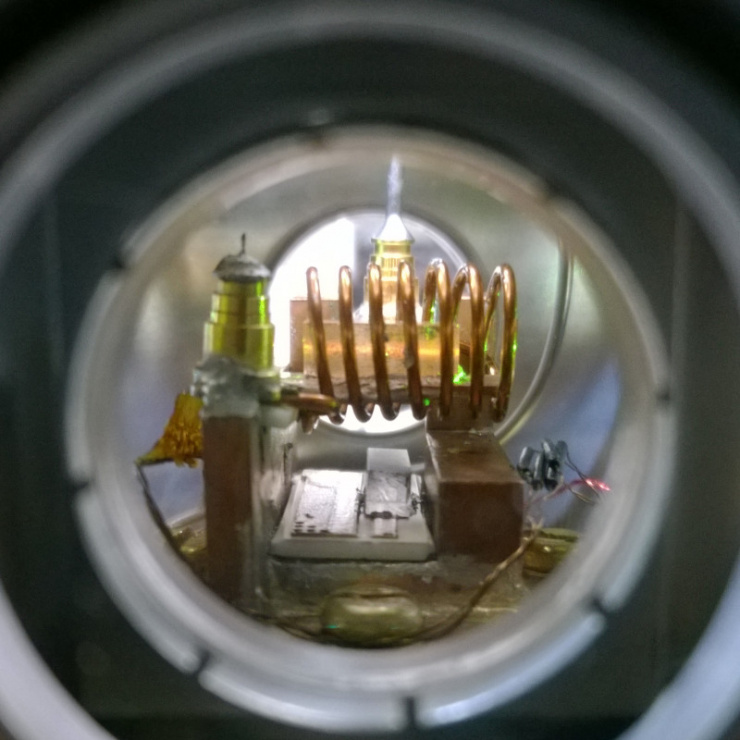
Quantum Memories
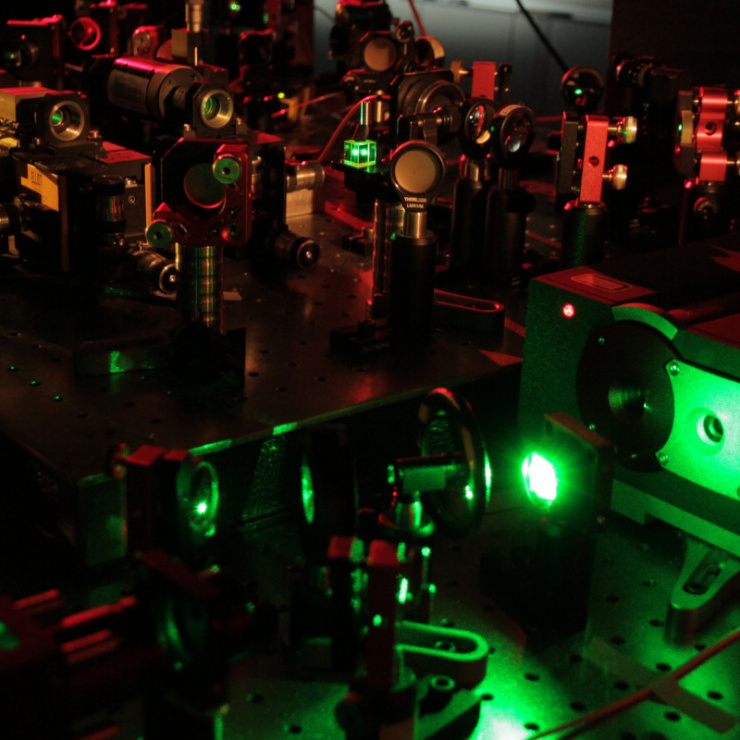
Quantum Photonics
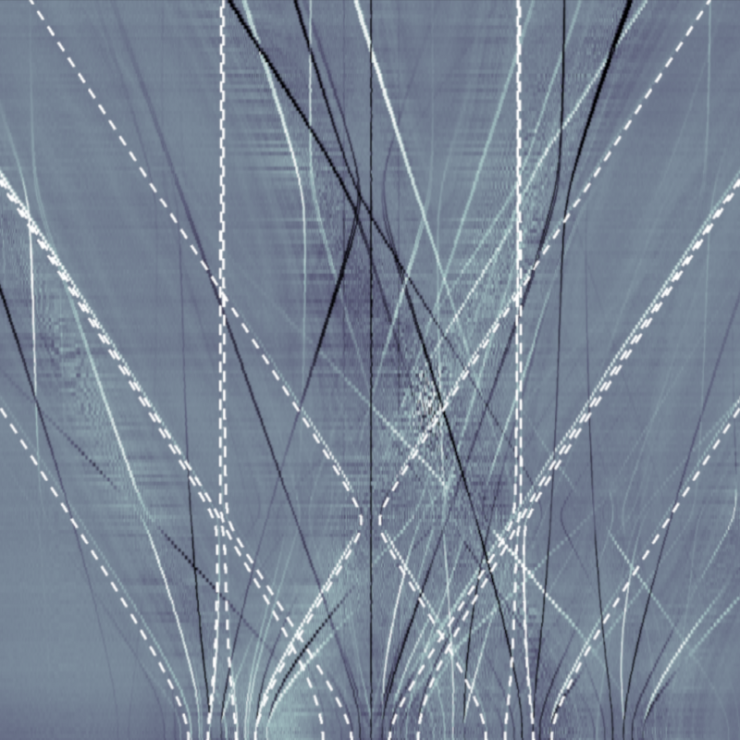
Optical and Spin Spectroscopy
News (archive)
Optical pumping simulations and optical Rabi frequency measurements in Eu:YSO under magnetic field
December, 2025

In this paper we present optical pumping simulations, as well as experimental considerations, to allow the operation of the AFC spin-wave quantum memory in 151Eu3+:Y2SiO5 under applied magnetic fields. From measurements of the optical Rabi frequencies the branching ratio table was reconstructed, providing a critical test of the spin Hamiltonian under magnetic field. More details can be found here.
Broadband and long-duration optical memory in 171Yb3+:Y2SiO5
November, 2025

We developed a new frequence-agile optical pumping laser setup for the Yb:YSO quantum memory. This allows for broadband and long-lived optical storage over 250 MHz for up to 125 µs and paves the way towards a 288 MHz-wide spin-wave storage. More details can be found in the article.
Quantum Networks using Rare-Earth Ions
June, 2025

This review, written in collaboration with Wolfgang Tittel at UniGe and Adam Kinos, Lars Rippe, and Andreas Walther at Lund University, highlights the potential of rare-earth ion-doped crystals for application as a platform for quantum networks. As a part of quantum repeaters, quantum memories based on ensembles of rare-earth ions are likely to become rapidly useful. The full article can be found here.
Efficient and reversible optical-to-spin conversion
April, 2025

The AFC spin-wave quantum memory protocol in a 151Eu3+:Y2SiO5 crystal offers the possibility of long storage times and on-demand readout. By applying a magnetic field and optimization using a developed simulation tool we were able to increase the conversion efficiency of the optical to spin conversion to up to 96% for a storage time of 500 µs! More details can be found in the article.
Swiss Quantum Call 2024 grant
December, 2024
The qram group (PI Mikael Afzelius) was awarded a 4-year 642 kCHF grant for the project "A quantum repeater node based on a broadband and highly multimode 171Yb:Y2SiO5 quantum memory", in the context of the Swiss Quantum Call 2024. In total 13 projects were supported, for a total of 16 MCHF. The funding source of this project will be SERI through the "Transitional measures".