
The eyes of a silkworm
Conference at Festival Histoire et Cité (https://histoire-cite.ch/) on April 2nd, 2025
When our economic life is mentioned in public debate today, it is usually in very abstract terms. Professional economists and policy-makers talk about money and finance, securities and derivatives, and many other phenomena that seem designed to distract our attention from any concrete material reality.
Yet we need look no further than the 18th century to find discussions of economic ideas firmly rooted in concrete material realities. In fact, some of the economic concepts and statements that continue to shape our lives today were forged at a time when early political economists were primarily concerned with animals and plants. In an upcoming session of the Geneva festival, Histoire et Cité, we will focus on one animal - the silkworm - whose astonishing capacity to transform itself gave rise to an entire production chain and piqued the interest of early generations of political economists who sought to profit from silk to promote the prosperity of their empires.
The different stages of silk production
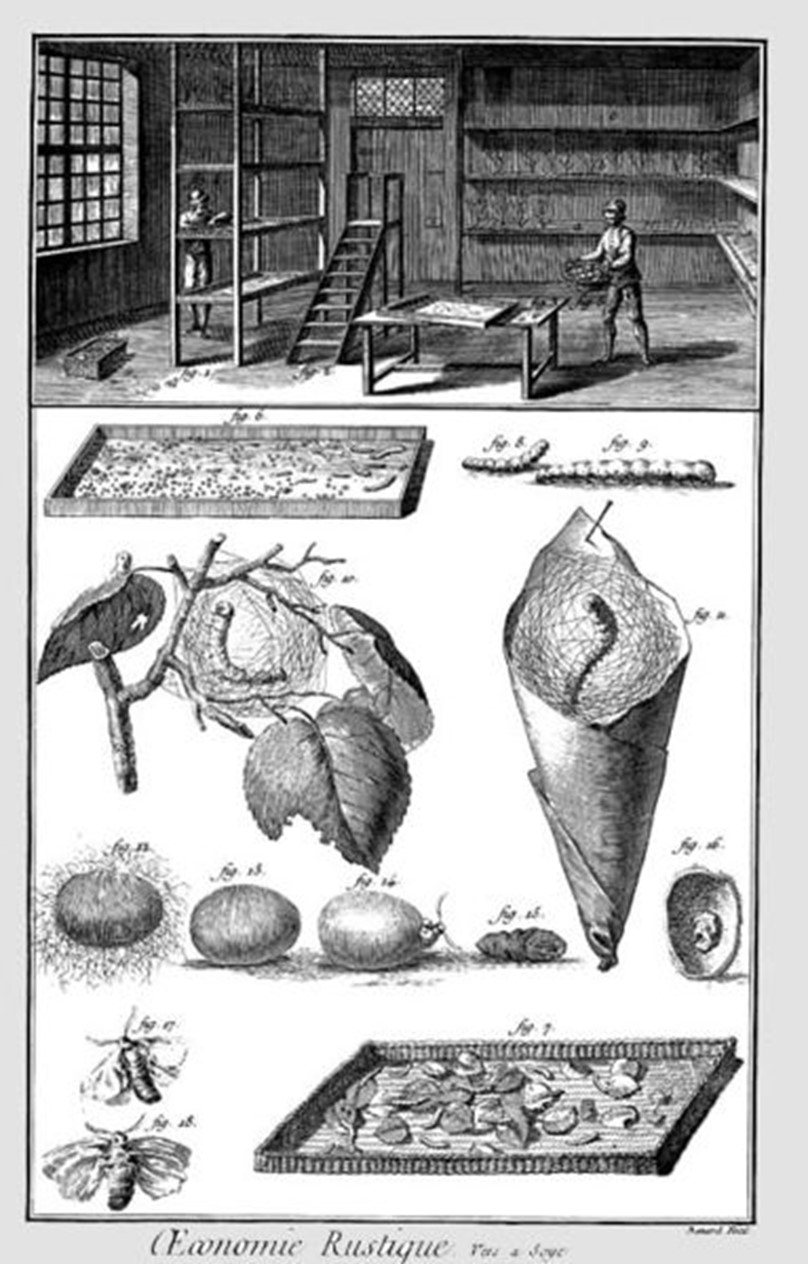
Source : ‘Oeconomie rustique’ in Diderot, Denis, D’Alembert Jean Le Rond, Encyclopédie ou dictionnaire raisonné des sciences, 23, « Agriculture » 1751-1780 , wikimedia commons : https://commons.wikimedia.org/wiki/File:Planche_Soie.jpg
The first part of the workshop will offer a practical and entertaining guide to the extraordinary processes by which the silkworm created a whole series of economic activities that linked different states across Europe in the 18th century. This first part will be presented in collaboration with the Association du Patrimoine Industriel (API) in Geneva, which will provide visual and tactile aids to understand the creation of silk and the different phases of its production. the silkworm and its industrial uses.
In the second part, we will give a few examples of the opportunities and challenges that the silkworm created for economists who sought to exploit its potential for the benefit of their kingdoms. France was literally obsessed with the staggering sums of money that flowed out of the country every year for silks imported from Italy. Throughout the 18th century, the French Crown tried every means possible to break its dependence on Piedmont, where the trade was managed by Protestant merchants known as “genevois” (ginevrini). As for Great Britain, it was too cold in the metropolis to raise silkworms with sufficient yield. Having stolen some of Piedmont's spinning technology in a far-fetched industrial espionage operation, the British Empire turned to its colonial territories, from the Thirteen colonies to Bengal, to raise its own precious silkworms.
Voltaire’s château in Ferney
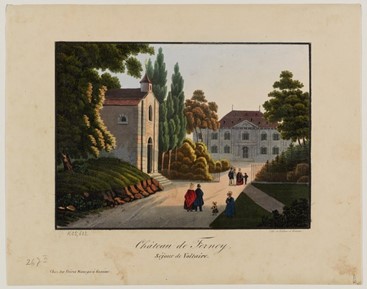
Source : Kellner, Joseph, ‘Chateau de Ferney, Séjour de Voltaire’, 19th century, Wikimedia commons: https://commons.wikimedia.org/w/index.php?search=Voltaire+chateau&title=Special:MediaSearch&go=Go&type=image
This global story even reached the very heart of Geneva: Voltaire, with the help of a Huguenot refugee, set up a silkworm nursery in the Saint Jean district, to supply a hosiery factory. In 1779, he proudly announced to La Marquise du Deffand: “I have found the secret of having silkworms in a country covered in snow for seven months of the year, and my silk, in my barbaric climate, is better than that of Italy.” By then, the famous Société économique de Berne, the first association of its type in continental Europe, was offering substantial incentives to promote the breeding of silkworms, mainly in Vaud.
Presenters : LORENZO AVELLINO, MARY O’ SULLIVAN & GAIA VALENTI (Fabric of Profit project (funded by the FNS), Institut Paul Bairoch d’histoire économique, Université de Genève) as well as FRANCK VACHERON (Association pour le Patrimoine Industriel, Genève)
Lorenzo Avellino, Mary O’Sullivan, Gaia Valenti
January 14th, 2024
FOOTNOTES
1 Voltaire, Lettre à Madame la Marquise du Deffand 6 septembre 1769, Œuvres complètes, 1828, p. 540.
2 https://hls-dhs-dss.ch/fr/articles/016420/2017-11-27/; Thierry Dubois, « Transferts de savoir entre les Sociétés économiques de Berne et d’Yverdon », Berner Zeitschrift für Geschichte, N° 02/14.
Jan 17, 2025