
Mechanizing "Swiss" Cotton Spinning under the Napoleonic Blockade: the Escher Wyss Archives
Escher Wyss on the Neumühlequai, 1860
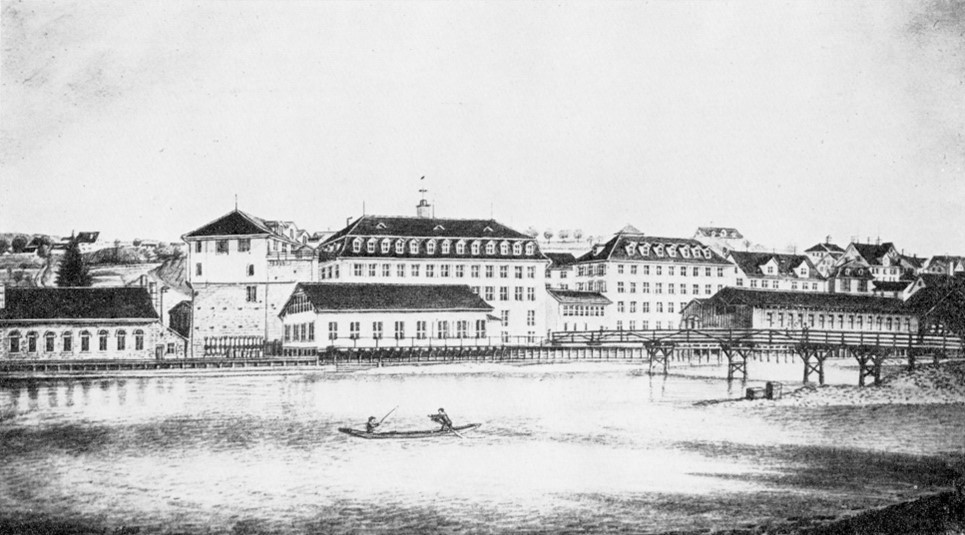
Source: ‘Die Fabriken des Unternehmens Escher-Wyss am Neumühlequai ca. 1860’, Fred Rihner, 1860.
https://de.wikipedia.org/wiki/Escher_Wyss_AG#/media/Datei:Bild_EscherWyss_19Jh_Neumuehlequai.jpg

Before moving to Ausserstihl, the industrial district in the Swiss city of Zurich, the famous Escher Wyss factory was located on the bank of the river Limmat, in a spot now favoured by tourists for an evening drink. The firm's renown among Swiss historians stems in part from its pioneering role in the industrial revolution, notably due its role in the early stages of mechanized spinning in present-day Switzerland.
Hans Caspar Escher
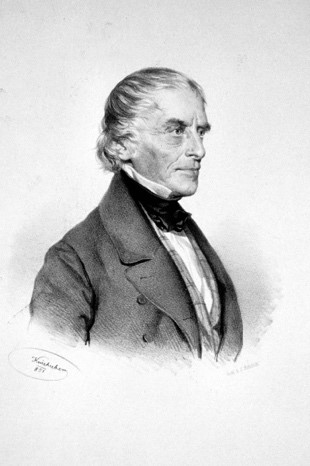
Source : Hans Caspar Escher, Lithography, 1851, https://commons.wikimedia.org/w/index.php?search=hans+caspar+escher+&title=Special:MediaSearch&go=Lire&uselang=fr&type=image
Mechanized spinning was introduced in Saint Gallen in 1801, when Marc Antoine Pellis installed mule jennies in his newly established factory there. His lead was soon followed with the opening of the Hard spinning factory in Wülflingen (1802), Näf in Rapperswil (1803) and Zellweger in Trogen (1804). Escher Wyss was founded in 1805 by Hans Caspar Escher, an architect, and Salomon von Wyss, a banker. Historians usually celebrate these developments as a crucial phase in the adoption by Swiss capitalists of cost-reducing spinning technology. Moreover, they emphasise the important facilitating role in this process of the protectionist measures that Napoleon introduced during the wars (1803-1815). In limiting British yarn imports to continental Europe, these measures reduced competition for cotton yarn spun in Zurich, fostering the creation of numerous mechanized spinning factories.
However, the Napoleonic Blockade had a downside, which is only seldom mentioned: access to materials, such as raw cotton, became increasingly difficult from 1803 due to tariffs and blockades. For instance, supplies of Brazilian cotton were severely impacted as trade routes through Italian ports like Genoa and Livorno were closed following Napoleon’s annexations. The growing difficulties in sourcing raw cotton led to rising costs and supply shortages, challenging the viability of mechanized production despite reduced competition for the yarn it spun. The problem was further aggravated by the fact that Levant raw cotton, which was less impacted by the blockade and Napoleon’s tariffs, could not be mechanically spun due to the shortness of its fibers.
It was these kinds of issues I had in mind when I visited the cantonal archives in Zurich to read the Escher Wyss’ archives, specifically its accounting and correspondence books. My goal was to understand how they ensured their raw cotton supply during these troubled times, and how the difficulties they encountered in sourcing raw materials affected the development of their spinning factory. My research there was a first step in a broader inquiry into the consequences of raw textiles shortages on Swiss industrialisation during the Napoleonic wars, which will contribute to my doctoral thesis on “Politics and Profits in Swiss Cotton and Silk Commodity Chains (1763-1848)” at the University of Geneva.
REFERENCES
Bergier, Jean-François. Naissance et croissance de la Suisse industrielle. Francke, 1974.
Bodmer, Walter. Die Entwicklung der schweizerischen Textilwirtschaft im rahmen der übrigen industrien und wirtschaftsweige. Verlag berichthaus Zurich., 1960.
Hoigné, Franz H. Gründung und Entwicklung der Spinnerei und Maschinenfabrik Escher Wyss & Cie., 1805-1859. Schulthess, 1916.
Veyrassat, Béatrice. Négociants et fabricants dans l’industrie cotonnière suisse, 1760-1840: aux origines financières de l’industrialisation. Lausanne: Payot, 1982.
Wartmann, Hermann. Industrie und Handel des Kantons St. Gallen auf Ende 1866: In geschichtlicher Darstellung. Herausgegeben vom kaufmännischen Directorium in St. Gallen. Bearbeitet von Hermann Wartmann. In Commission bei Huber & Comp. (F. Fehr), 1875.
Gaia Valenti
The Fabric of Profit, University of Geneva
September 2025
Feb 5, 2025