
Trade During Wars: Intersections Between Cotton, Profit, & Political Economy
(The Case of the French Wars)
When we think of the French Revolutionary and Napoleonic Wars (1793–1815), we imagine naval blockades, stifled economies, and clashes between Britain’s maritime empire and France’s continental power. Yet, amid this turbulence, one sector of the French economy not only survived but expanded: the cotton industry. This paradox raises a crucial question: how did French spinners manage to keep their machines and wheels turning when the seas were supposedly closed to the import of a raw material that was not produced in France? The experience of Brazilian cotton during the French Wars can shed light on this issue, helping us understand the actions of merchants, statesmen, and industrialists who ensured its passage across oceans and borders despite the hostilities. From this perspective, we can see how war, profit, and political economy became intertwined in unexpected ways.
Britain is often portrayed as invincible, primarily due to its naval supremacy that ensured nearly constant access to cotton from the West Indies (the Caribbean), continental Europe, and the United States. France, by contrast, from the Jacobins to Napoleon Bonaparte, is generally depicted as isolated, dependent on protectionist tariffs, and struggling to keep pace with Britain’s industrialization1. But cotton tells another story.
With the loss of Saint-Domingue after the 1791 slave revolt led by Toussaint Louverture, a crucial pillar of France’s traditional supply of raw cotton collapsed, and the constant blockades of one of the main ports for cotton in France meant that Le Havre lost its traditional relevance for the French cotton industry. The French turned to Brazil, then under Portuguese rule, which exported bales of raw cotton to Lisbon from slave plantations in Pernambuco and Maranhão. From Lisbon, merchants re-exported Brazilian cotton, valued for its long fibers, and it became the lifeblood of Rouen’s workshops. In the first seven years of the 19th century, more Brazilian cotton entered France than from any other source, including the U.S2.
The vulnerability of France’s cotton supply shaped its policies. Tighter blockades from 1808 onward made Napoleon wary of reliance on overseas fibers, and he promoted alternatives, sponsoring linen-spinning contests and investing in wool for the army. Yet cotton’s appeal—cheap, versatile, elegant—remained strong in France. Its cotton industry grew, even under blockade, because merchants and states bent and circumvented the rules of war. For political economy, this behaviour proved to be crucial. Protectionism aimed to shield France from British goods, but without raw materials, the system would have collapsed. Instead, France’s mercantilism was riddled with contradictions and loopholes -- barriers to imports on paper, licenses and other practices that allowed materials in -- and an industrial policy built as much on pragmatism as ideology.
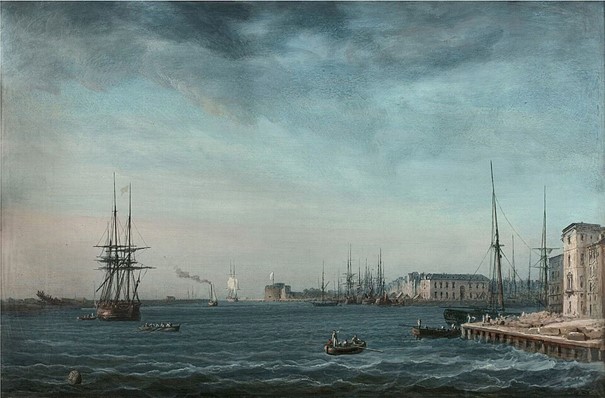
Source: Wikimedia Commons. Tableau représentant l'entrée du port du Havre dans son état Lamandé, à la fin du XVIIIe siècle, by Alexandre-Jean Noël (1752-1834).
But how exactly did this happen? Let us return to the war’s beginning in 1793, which brought innovations in trade. Direct Lisbon–France commerce was technically illegal, but French consuls and merchants found ways to circumvent the restrictions. Neutral ships—especially American vessels under President George Washington’s neutrality policy and Scandinavian ones under monarchs like Gustav IV of Sweden—became crucial. Hamburg emerged as a key hub: after the French invasion of the Netherlands in 1795, Hamburg absorbed Amsterdam’s commercial networks, becoming the main entrepôt for Brazilian cotton bound for France3.
Figures like Lisbon merchant Brás Francisco Lima illustrate how these networks worked. Lima coordinated purchases of Brazilian cotton, contracted with American captains for transport, and issued bills of exchange payable in Paris. In one notorious 1793 case—drawn from the Prize Papers—a shipment destined for Jean-Baptiste Caumont, a Rouen spinner, was seized by a British warship, with all its raw cotton confiscated, leaving Lisbon and Rouen merchants with heavy losses4. Cotton trade in the French Wars was risky trade, but overall the calculation was that commerce remained possible—and profitable—as long as the British did not suspect the cargo belonged to their French enemies, a fact concealed with false papers. Neutrality provided sufficient cover to keep the trade in Brazilian cotton alive, with Britain taking a tolerant view of the matter since its financiers also profited from bills of exchange and reexport commissions. What appeared as economic warfare was, in practice, a negotiation between warring states, merchants, and insurers, each bending or avoiding the rules to keep trade profitable.
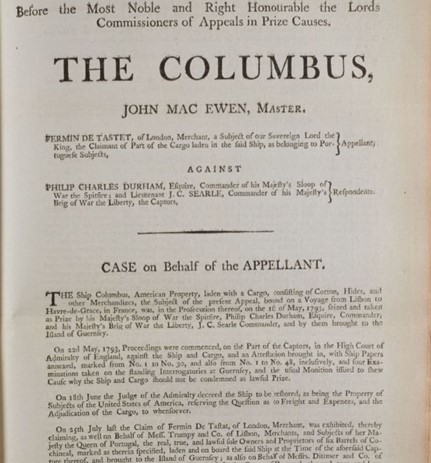
Source and note: The National Archives, Kew, Printed prize appeal from the High Court of Admiralty. Captured ship: Columbus (master John McEwen), taken on 1 May 1793, bound printed appeal with manuscript decree of 28 March 1795.
The brief Peace of Amiens (1802–1803) reopened direct trade, but when war resumed, merchants had to innovate again. With Le Havre under constant blockade, raw cotton from Lisbon was diverted to Cherbourg, Caen, and Nantes. The fortified port of Cherbourg offered some protection against British patrols. Caen was close to Rouen and Nantes, connected to Paris via the Loire, became a crucial supply point for the capital’s important cotton workshops. Industrialists seized the opportunities. Christophe-Philippe Oberkampf, famous for his printed textiles near Paris, ordered bales of Pernambuco cotton through merchants like Ratton & Sons in Lisbon. He advised splitting shipments across several vessels to reduce risks and even suggested foregoing insurance if costs were prohibitive. His correspondence shows how industrial fortunes depended heavily on flexible but risky trade routes5.

Source: Wikimedia Commons, Jácome Ratton 1736-1820, Franco-Portuguese industrialist, Unknown source.

Source: Christophe-Philippe Oberkampf (1738-1815), French industrialist, 1815, Musée de la toile de Jouy.
At the state level, Jean-Baptiste de Champagny, Napoleon’s Minister of the Interior, reported in 1807 that France had imported 52,000 bales of cotton from Portugal in 1806—more than the 41,000 to Britain6. The implication was both political and economic: through cotton, France could maintain its important industrial activity in cotton. This was a moment where profit and political economy aligned. Merchants profited from the increased demand, spinners found protected markets for their products, while Napoleon's government managed to promote industry for a few years despite the blockade.
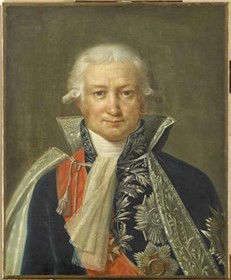
Source: Wikimedia Commons. Jean-Baptiste de Nompère de Champagny (1756-1834), by Antoine Ansiaux in 1850.
In response to a British Order in Council of 16 May 1806, which declared French ports to be under blockade, Napoleon issued the Berlin Decree of 21 November 1806, which forbade French, allied or neutral ships from trading with Britain. The Berlin Decree is seen as inaugurating the Continental System, which aimed to isolate Britain economically by closing European markets to its goods.. In 1807, after the French invasion of Portugal and British naval control of Lisbon, old channels collapsed. This was a decisive moment, but merchants responded boldly. Bales stockpiled in Lisbon were transported overland across Spain into France, passing through cities like Badajoz, Salamanca, and Valladolid before reaching Nantes, Rouen, or Mulhouse7. Lisbon merchant Jacome Ratton, later accused of conspiring with the French, admitted in his memoirs that he shipped cotton in mule caravans and received gold from French clients—though he insisted all Lisbon merchants did the same.
Another adaptation was the license system. From 1810 onward, both Britain and France issued thousands of special authorizations. In London, the Board of Trade allowed Brazilian cotton—stockpiled in large quantities and unsellable in Britain’s saturated market—to be shipped across the Channel, sometimes directly to Rouen8. This occurred because prices were far more attractive on the other side: cotton cost 2 shillings in London but up to 8 in Paris. And despite high prices, French spinning was protected, which could offset the expensive raw material, although widespread contraband continued to undermine these protective measures9. Even French bankers—like Delessert, Vassal, and Bidermann—applied for French government licenses to profit from this trade10.
This reveals the deeper logic of political economy. Officially, the Continental System aimed to retaliate against and punish Britain. In practice, it created shortages that drove up French cotton prices and made the licensed—and smuggled—cotton trade even more profitable. The state itself profited by taxing licenses, while merchants and bankers amassed fortunes. Profit, in other words, became the mechanism through which political economy bent the rules of war. But profit was not distributed evenly. Geography shaped outcomes. With Le Havre blockaded, Rouen’s primacy declined, while Paris, Mulhouse, and the North emerged as new industrial centers. Merchants and manufacturers closer to alternative ports or with lower overland costs enjoyed competitive advantages. In practice, war redrew France’s industrial map11.
What can be learned from these episodes is that disruption did not destroy markets; instead, it reconfigured them. Profits flowed to those who navigated blockades, exploited neutrality, or secured licenses. Political economy during the French Wars was less about absolute closure and more about managing scarcity in ways that generated revenue for the state and fortunes for well-connected merchants.
Thus, the story of Brazilian cotton during the French Wars complicates the classic narrative of British industrial superiority and supposed French weakness. France’s cotton industry grew not despite blockades, but because merchants, consuls, and governments found ways to keep trade alive. Seen from this perspective, figures like Napoleon, Oberkampf, Ratton, and Champagny remind us that industrialization was not only about machines or labor. It was also about trade routes, neutral flags, and the manipulation of political economy in times of war. Even Britain, through licenses, ended up facilitating French supply when profits aligned. These were difficult times, but far from isolation, France’s path to industrialization was one of adaptation, improvisation, and resilience. Blockades created new networks, shifted industrial centers, and reshaped the geography of profit. In this sense, the French Wars were not only a story of conflict but also of connection—in which Brazilian fibers, Portuguese merchants, and French industrialists together wove the fabric of continental industrialization.
FOOTNOTES
1 For an overview, see Jeff Horn, The Path Not Taken: French Industrialization in the Age of Revolution, 1750-1830 (MIT Press, 2006).
2 Gavin Daly, Inside Napoleonic France: State and Society in Rouen, 1800-1815 (Ashgate, 2001).
3 Patrick Crowhurst, The French War on Trade: Privateering, 1793-1815 (Scolar Press, 1989), 9–11; Paul Butel, ‘Revolution and the Urban Economy: Maritime Cities and Continental Cities’, in Reshaping France: Town, Country, and Region during the French Revolution, ed. Alan I. Forrest and Peter Jones (Manchester University Press, 1991), 42; Katherine Aaslestad, ‘Paying for War: Experiences of Napoleonic Rule in the Hanseatic Cities’, Central European History 39, no. 4 (2006): 646; Réka Juhász, ‘Temporary Protection and Technology Adoption: Evidence from the Napoleonic Blockade’, American Economic Review 108, no. 11 (2018): 3339–76.
4 The National Archives, Kew, Printed prize appeal from the High Court of Admiralty. Captured ship: Columbus (master John McEwen), taken on 1 May 1793, bound printed appeal with manuscript decree of 28 March 1795.
5 Stanley D. Chapman and Serge Chassagne, European Textile Printers in the Eighteenth Century: A Study of Peel and Oberkampf (Heinemann Educational: Pasold Fund, 1981), 163–64, 241; Louis Bergeron, Banquiers, Négociants et Manufacturiers Parisiens Du Directoire à l’Empire (Ecole des hautes etudes en sciences sociales, 1978), 228–29, 238, 370.
6 Serge Chassagne, ‘L’enquête, Dite de Champagny, Sur La Situation de l’industrie Cotonnière Française Au Début de l’empire (1805-1806)’, Revue d’histoire Économique et Sociale 54, no. 3 (1976): 342.
7 Abel Poitrineau, ‘Les Relations Économiques Franco-Espagnoles Vues à Travers Les Papiers de La Commission Impériale Des Indemnités de 1809-1810’, Actes Du 94e Congrès National Des Sociétés Savantes, Pau, 1969, Actes Du 94e Congrès National Des Sociétés Savantes. Tome 1, 1971, 283, 287–88, 290.
8 House of Commons Papers, Paper Number 349, Volume 3, p. 67.
9 Gavin Daly, ‘English Smugglers, the Channel, and the Napoleonic Wars, 1800–1814’, Journal of British Studies 46, no. 1 (2007): 30–46.
10 Louis Bergeron, Banquiers, Négociants et Manufacturiers Parisiens Du Directoire à l’Empire (Ecole des hautes etudes en sciences sociales, 1978), 285.
11 Réka Juhász, ‘Temporary Protection and Technology Adoption: Evidence from the Napoleonic Blockade’, American Economic Review 108, no. 11 (2018): 3339–76.
Felipe Souza Melo
The Fabric of Profit, University of Geneva
September 2025
Coming soon as Fabric of Profit working paper, #4
Feb 5, 2025