
Dies academicus awards
DOCTORATE HONORIS CAUSA

The University grants the doctorate honoris causa in recognition of the excellence and influence of personalities in the main fields of knowledge covered by the University. The degree is awarded in recognition of an exemplary commitment and career that have made a significant contribution to the advancement of science, culture or social and economic development. The title is also awarded in recognition of an exceptional scientific career or outstanding scientific merit in the fields of research and education at the University of Geneva. Honorary doctorates are awarded on the occasion of the Dies academicus List of Doctor honoris causa since 1878.
UNIVERSITY MEDAL
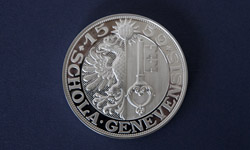 The awarding of a University Medal (or University Recognition Medal) was decided by the University Senate in 1931 to express the institution's gratitude for outstanding services rendered to the University of Geneva. The first medal was awarded to Charles-Eugène Guye to mark his thirty years as a professor. It is awarded each year on the occasion of the Dies academicus. Recipients may be institutions or individuals. To date, the medal has been awarded to people both inside and outside the University, with or without academic rank.
INNOVATION MEDAL
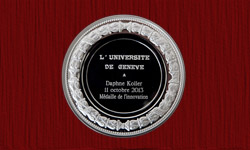
The University of Geneva's Innovation Medal was awarded for the first time in 2013, with the aim of expressing the institution's recognition of a person or entity for a significant contribution that opens up new perspectives in the way the academic world can contribute to the common good. The award underlines the importance of creativity and the potential of ideas to help change the world. The first Innovation Medal was awarded to Daphne Koller, professor at Stanford University and co-founder of the online course platform Coursera, for her pioneering role in the development of distance learning. The Innovation Medal is awarded each year on the occasion of the Dies academicus.
NESSIM-HABIF WORLD PRIZE
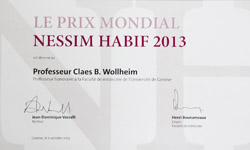 The Nessim-Habif World Prize is awarded to an academic figure who has illustrated, through particularly original and in-depth thought and work, a field of the exact, medical or human sciences. It was awarded for the first time at the 1963 Dies academicus by the Faculty of Science. Since then, it has been awarded annually by the Faculty of Science, the Faculty of Arts, the Faculty of Medicine and the Geneva Graduate Institute (IHEID).
LATSIS PRIZE
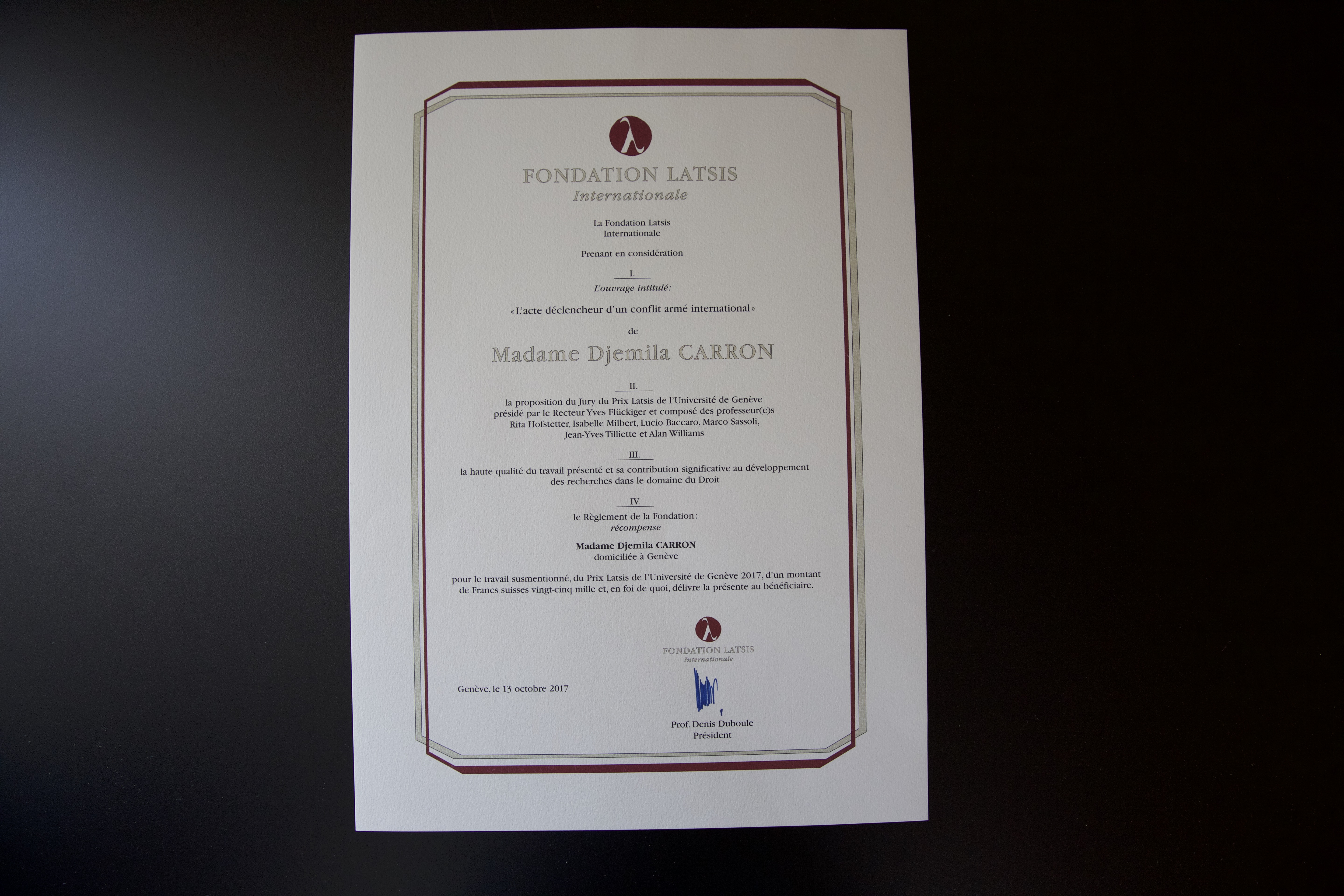
The Latsis Foundation introduced the Latsis Prizes in Switzerland in 1983. Awarded annually, the aim of these prizes is to encourage and reward young researchers in recognition of important and promising scientific and technological contributions made in Switzerland.
The Latsis University Prizes are awarded by the University of Geneva, the University of St. Gallen and the Swiss Federal Institutes of Technology in Lausanne (EPFL) and Zurich (EPFZ). They are awarded at the official ceremonies of these four institutions. For the UNIGE, the prize is awarded during the Dies academicus.