
Tracing the history of the Dies academicus
ACADEMIC DRESS
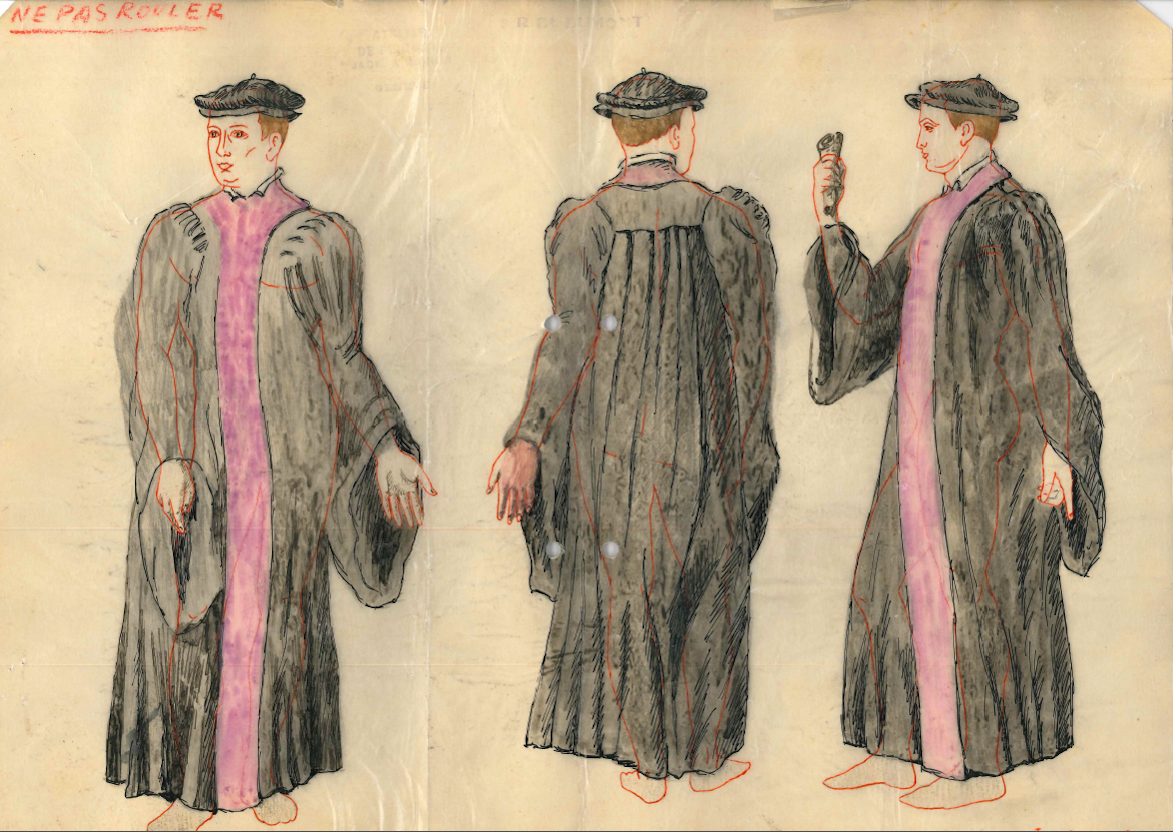
On 22 December 1922, Rector William Rappard submitted the first questions concerning proposed regalia to be worn exclusively abroad and an insignia to be worn in Geneva. In 1935, the presence of a Swiss delegation at the French Academy's tercentenary celebrations once again raised the question of regalia to be worn on an exceptional basis.
In a letter from the Council of State dated 6 August 1941, and at the request of Mr Adrien Lachenal, then head of the Department of Public Education, Rector Pittard studied the question of academic robes for university ceremonies.
In 1957, the first gown was designed on the model of those of the Reformers, and more particularly those of Theodore de Bèze. It was black, cut from a very fine woollen fabric. The front was adorned with a purple velvet layer that passes under the collar and falls to the bottom of the gown. The back is divided into flat pleats, like that of the front, at the level of the sleeve gathers. Later, as purple no longer uniformly represented the University's faculties, the gown’s velvet came in the following variations:
- For Sciences, green trim
- For Humanities, ultramarine blue trim
- For Law, bright red trim
- For Economic and Social Sciences, golden yellow trim
- For Medicine, carmine trim
- For Theology, purple trim
On 5 December 1957, the University Senate decided to introduce the wearing of robes by professors during the university's ceremonies. In taking this decision, the Senate revived a tradition that has been honoured uninterruptedly ever since.
THE RECTOR'S CHAIN
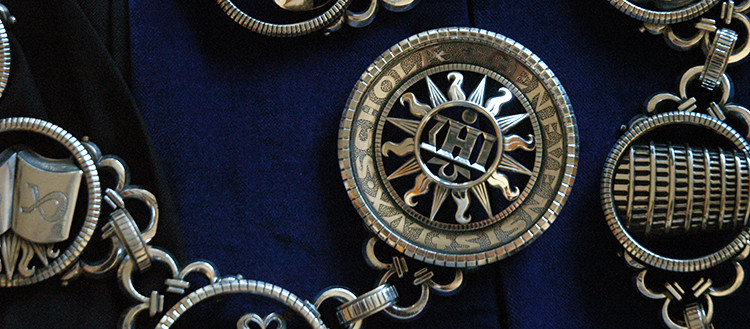
In 1958, Patek Philippe, wishing to be associated with the events of the Fourth Centenary of the University of Geneva, offered the latter the Rector's Chain. Designed by Gilbert Albert and made by Albert Pellarin in old silver, it took more than 450 hours to make. It was presented to the university authorities at a reception in the Salle du Sénat on 3 June 1958 and was worn for the first time at the Dies academicus on 5 June 1958 by Rector Paul-E. Wenger. The six faculties are represented by their emblems in seven links. A new link was added for the Faculty of Psychology and Educational Sciences in 1976. In 2015, two new emblems were created: a Moebius ring for the Faculty of Economics and Management, and a Tower of Babel for the Faculty of Translation and Interpreting.
THE CEREMONIAL MACE
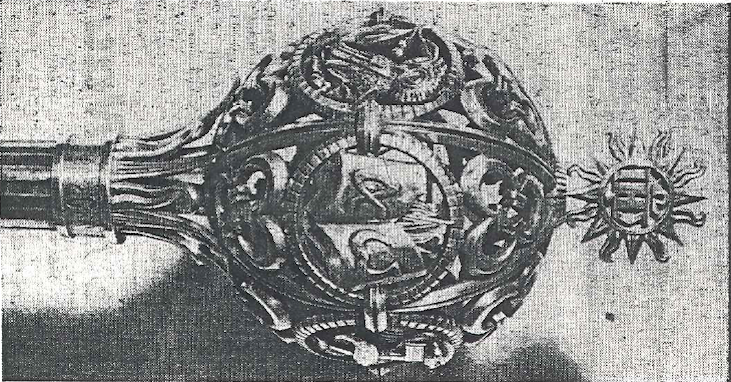
After the Rector's Chain in 1958, the jewellers at Patek Philippe made and presented the University of Geneva with a mace to be used by the marshal during its ceremonies. It was presented to the University Senate on 26 May 1959. Made of solid silver in the same style as the chain, it weighed more than a kilo and required more than 500 hours of work. The six faculties are symbolically represented on the sphere, surmounted by a sun whose centre is occupied by the shield of Geneva and the arms of the University. Within the removable handle is a parchment on which is written:
We, the companions of the Patek-Philippe jewellery workshop, donate to the University of Geneva this mace that we made for its fourth centenary.
Gilbert Albert, designer and jeweller, from Geneva.
Lucien Tournour, jeweller, from Carouge.
Georges Mobèche, jeweller, from Paris.
Marguerite Koch, enameller, from Geneva.
Claude Tschachtli, jeweller, from Fribourg.
André Zanotti, jeweller, from Piedmont.
Claude Bernillon, jeweller, from Lyon.
Robert Mouther, apprentice, from Valais.
Geneva, 5 June 1959.