
The future Einstein Telescope appoints a spokesperson from UNIGE
Published on
UNIGE Professor Michele Maggiore has been appointed spokesperson for the future European gravitational-wave observatory.

The Einstein Telescope collaboration, set to become Europe’s next-generation observatory for gravitational-wave detection, has appointed Michele Maggiore, professor in the Department of Theoretical Physics at the Faculty of Science of the University of Geneva (UNIGE), its spokesperson. Produced by the collision of black holes or neutron stars, these tiny ripples in spacetime are becoming one of the major new tools of modern astrophysics. The project brings together more than 2,000 scientists from over 90 research units in more than 30 countries and represents an estimated €2 billion investment.
Capable of detecting up to a thousand times more gravitational-wave events than the current LIGO–Virgo–KAGRA detector network (in Italy, the United States and Japan), the future Einstein Telescope will be built 200 to 300 meters underground, with arms 10 to 15 kilometers long, sheltered from vibrations caused by human activity. Three sites are currently under consideration to host the experiment: Sardinia; the border region between the Netherlands, Belgium, and Germany; and Saxony. The detector could be located in a single site or distributed among two sites.
The Einstein Telescope will enable scientists to study the formation of black holes, the structure of neutron stars and the nature of the Universe shortly after the Big Bang.
This third-generation observatory will continuously monitor the length of its detection arms using lasers and suspended mirrors. The slightest variation—up to millions of times smaller than the diameter of an atomic nucleus—will reveal the passage of a gravitational wave.
The scientific collaboration behind the project, supported by the European Commission, has appointed Michele Maggiore, full professor in the Department of Theoretical Physics, within the Physics Section of the Faculty of Science at UNIGE, its spokesperson. Already a member of the Executive Board and co-chair of the Observational Science Board, he will represent the whole collaboration, after having coordinated its scientific activities.
UNIGE contributes through the Gravitational Wave Science Centre
Several UNIGE teams are already involved in the project, alongside scientists from several Swiss universities and research institutes, through the Gravitational Wave Science Centre (GWSC), founded in 2022 and hosted by the University. The centre brings together specialists in gravitational-wave research from the departments of astronomy, theoretical physics, and nuclear and particle physics.
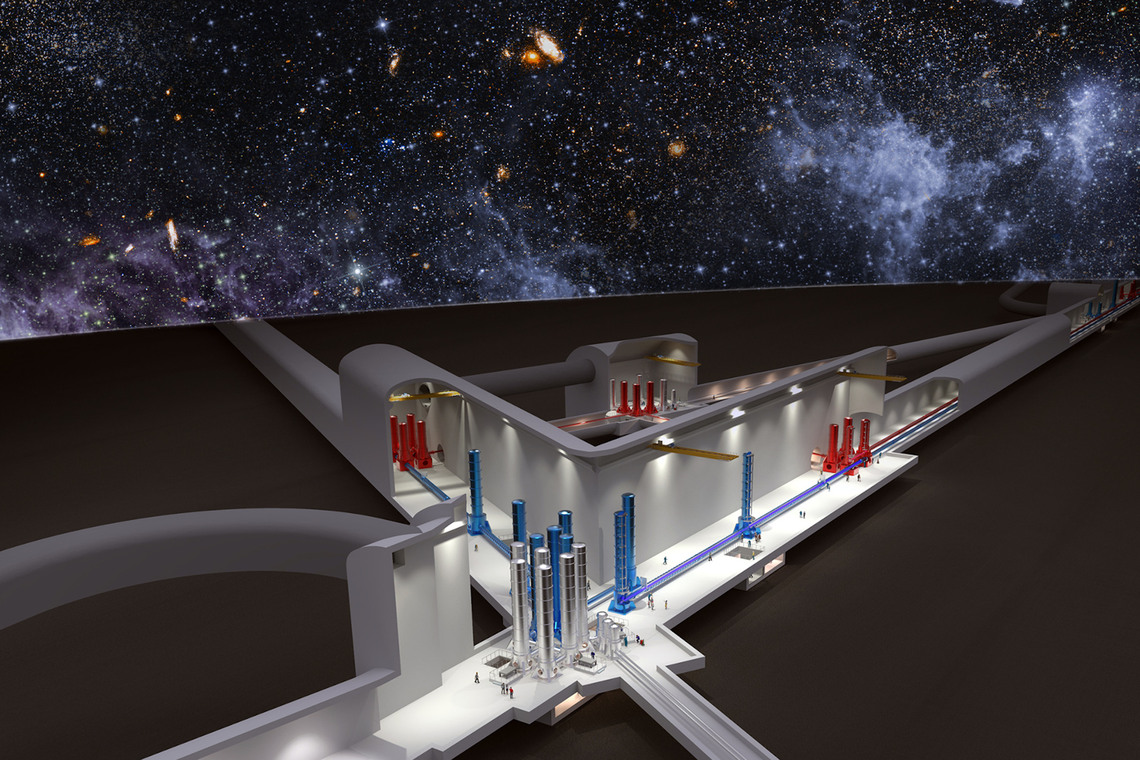 The Einstein Telescope will continuously monitor the length of its detection arms using lasers and suspended mirrors. © Einstein Telescope
Exploring the Universe and testing relativity
The Einstein Telescope will enable scientists to study the formation of black holes, the structure of neutron stars and the nature of the Universe shortly after the Big Bang. It will also offer the opportunity to test Albert Einstein's theories on a cosmological scale.
Estimated in 2021 at €2 billion, the project is included in the roadmap of the European Strategy Forum on Research Infrastructures (ESFRI), which defines priorities for major research infrastructures in Europe. Funding will be provided by the partner countries hosting the participating universities and research institute. In Switzerland, the project is currently being submitted to the State Secretariat for Education, Research and Innovation (SERI) roadmap.
Preparatory work on site is expected to begin in 2028, with commissioning planned for the second half of the 2030s.
Contact
Michele Maggiore
Full Professor
Department of Theoretical Physics
Section of Physics Faculty of Science
UNIGE
+41 22 379 63 81