
Extremely massive stars forged the Universe’s oldest star clusters
A team of astronomers from ICREA , the Institute of Cosmos Sciences of the University of Barcelona (ICCUB), the Institute of Space Studies of Catalonia (IEEC) and the University of Geneva has developed a groundbreaking model that reveals how extremely massive stars (EMSs) – more than 1,000 times the mass of the Sun - shaped the birth and early evolution of the Universe’s oldest star clusters. Published in Monthly Notices of the Royal Astronomical Society , the study shows how these short-lived stellar giants profoundly influenced the chemistry of globular.
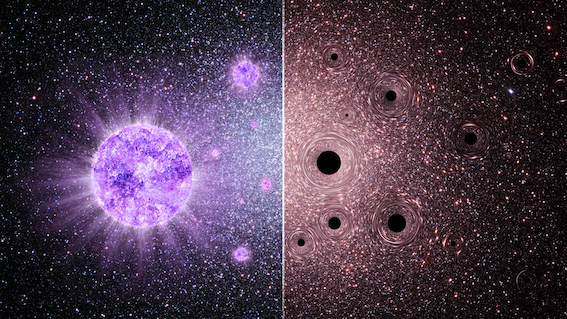
Globular clusters: the ancient archives of the Universe
Globular clusters are dense, spherical groups of hundreds of thousands to millions of stars, found in nearly all galaxies including our Milky Way. Most of them are more than 10 billion years old, implying that they formed shortly after the Big Bang. Their stars display puzzling chemical signatures - including unusual abundances of helium, nitrogen, oxygen, sodium, magnesium, and aluminum - that have defied explanation for decades. These “multiple populations” point to complex enrichment processes during cluster formation from extremely hot “polluters”.
A new model for cluster formation
The new study builds on the inertial-inflow model of massive star formation, extending it to the extreme environments of the early Universe. The researchers show that in the most massive clusters, turbulent gas naturally gives rise to extremely massive stars (EMSs) weighing between 1,000 and 10,000 solar masses. These accreting EMSs release powerful stellar winds rich in the products of hydrogen burning at high temperatures, which then mix with the surrounding pristine gas and forms the chemically distinct stars.
“ Our model shows that just a few extremely massive stars can leave a lasting chemical fingerprint on an entire cluster ,” says Mark Gieles, ICREA professor at ICCUB and first author of the study. “ It finally links the formation physics of globular clusters to the chemical signatures we observe today .”
This process unfolds rapidly - within 1 to 2 million years - before any supernovae explode, ensuring that the cluster’s gas remains free of supernova pollution.
« We knew that extremely massive stars would produce the right chemical abundance patterns through the nuclear reactions happening in their core. The model provides now a natural path to form these stars in very dense and compact star clusters », add Laura Ramirez Galeano, Ph.D student at the astronomy department of UNIGE and co-author of the paper.
A new window on the early Universe and black holes
The implications reach far beyond the Milky Way. The authors propose that the nitrogen-rich galaxies discovered by the James Webb Space Telescope (JWST) are likely dominated by EMS-rich globular clusters that formed during the earliest stages of galaxy assembly.
These first galaxies may be shaped by extremely massive stars. These colossal stars likely ended their lives collapsing into intermediate-mass black holes (more than 100 solar masses), which could possibly be found via gravitational-wave signals. The research provides a unifying framework connecting star-formation physics, cluster evolution, and chemical enrichment. It suggests that EMSs were key engines of early galaxy formation, simultaneously enriching globular clusters and forming the first black holes.
"Several of these early galaxies have been discovered by our colleagues at the astronomy department of UNIGE and we are motivated to continue unraveling their mysteries." concludes Corinne Charbonnel, Professor at the department of astronomy of UNIGE and co-author of the publication.