
The Webb space telescope pushes boundaries of observable universe closer to Big Bang
NASA’s James Webb Space Telescope has topped itself once again, delivering on its promise to push the boundaries of the observable universe closer to cosmic dawn with the confirmation of a bright galaxy that existed 280 million years after the big bang. The newly confirmed galaxy, MoM-z14, holds intriguing clues to the universe’s historical timeline and just how different a place the early universe was than astronomers expected. The study, lead by an international team of astronomers, among whom researchers from UNIGE, is published in the Open Journal of Astrophysics.
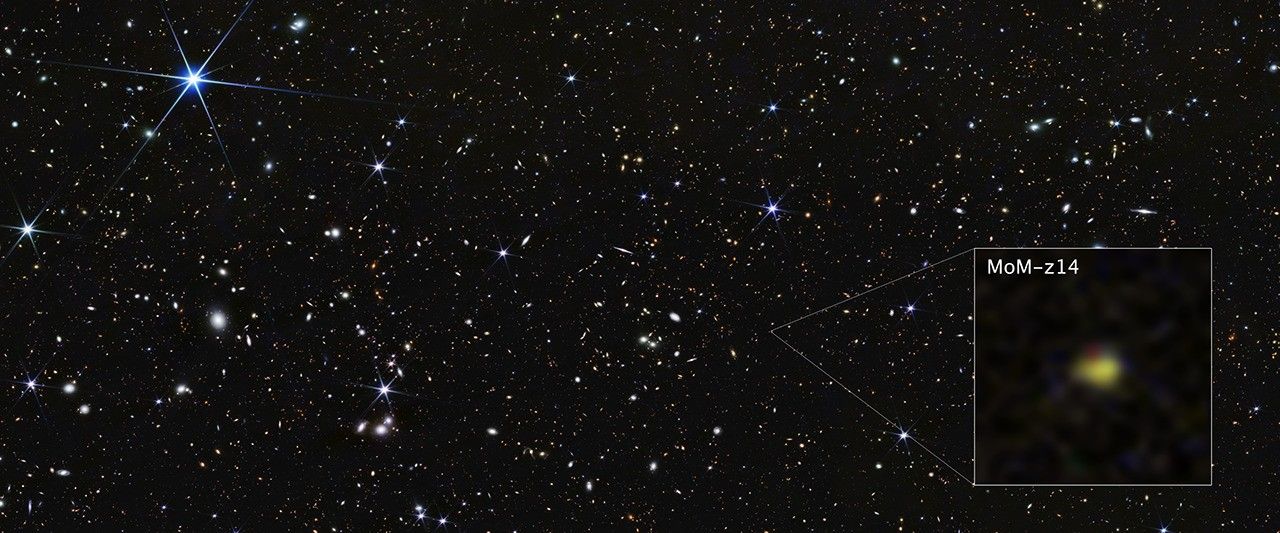 NASA’s James Webb Space Telescope shows galaxy MoM-z14 as it appeared in the distant past, only 280 million years after the big bang. Credits: Image: NASA, ESA, CSA, STScI, Rohan Naidu (MIT); Image processing: Joseph DePasquale (STScI)
“With Webb, we are able to see farther than humans ever have before, and it looks nothing like what we predicted, which is both challenging and exciting,” said Rohan Naidu of the Massachusetts Institute of Technology’s (MIT) Kavli Institute for Astrophysics and Space Research, lead author of the study.
Due to the expansion of the Universe, discussion of physical distances and “years ago” becomes tricky when looking this far. Using Webb’s NIRSpec (Near-Infrared Spectrograph) instrument, astronomers confirmed that MoM-z14 has a cosmological redshift of 14.44, meaning that its light has been travelling through (expanding) space, being stretched and “shifted” to longer, redder wavelengths, for about 13.5 of the Universe’s estimated 13.8 billion years of existence.
“We can estimate the distance of galaxies from images, but it’s really important to follow up and confirm with more detailed spectroscopy so that we know exactly what we are seeing, and when,” said Pascal Oesch of UNIGE, co-principal investigator of the survey.
Intriguing Features
MoM-z14 is one of a growing group of surprisingly bright galaxies in the early universe – 100 times more than theoretical studies predicted before the launch of Webb, according to the research team. The chasm between theory and observation related to the early Universe is growing and presents compelling questions. "One place researchers and theorists can look for answers is the oldest population of stars in the Milky Way galaxy," explains Andrea Weibel, postdoctoral researcher at UNIGE and member of the research team. A small percentage of these stars have shown high amounts of nitrogen, which is also showing up in some of Webb’s observations of early galaxies, including MoM-z14.
“We can take a page from archeology and look at these ancient stars in our own galaxy like fossils from the early Universe, except in astronomy we are lucky enough to have Webb seeing so far that we also have direct information about galaxies during that time. It turns out we are seeing some of the same features, like this unusual nitrogen enrichment,” said Naidu.
With galaxy MoM-z14 existing only 280 million years after the big bang, there was not enough time for generations of stars to produce such high amounts of nitrogen in the way that astronomers would expect. One theory the researchers note is that the dense environment of the early Universe resulted in supermassive stars capable of producing more nitrogen than any stars observed in the local Universe.
The galaxy MoM-z14 also shows signs of clearing out the thick, primordial hydrogen fog of the early universe in the space around itself. One of the reasons Webb was originally built was to define the timeline for this “clearing” period of cosmic history, which astronomers call reionization. This is when early stars produced light of high enough energy to break through the dense hydrogen gas of the early universe and begin travelling through space, eventually making its way to Webb, and us. Galaxy MoM-z14 provides another clue for mapping out the timeline of reionization, work that was not possible until Webb lifted the veil on this era of the Universe.
Legacy of Discovery Continues
Even before Webb’s launch, there were hints that something very unanticipated happened in the early universe, when NASA’s Hubble Space Telescope discovered the bright galaxy GN-z11 400 million years after the big bang. Webb confirmed the galaxy’s distance — at the time the most distant ever. From there Webb has continued to push back farther and farther in space and time, finding more surprisingly bright galaxies like GN-z11.
As Webb continues to uncover more of these unexpectedly luminous galaxies, it’s clear that the first few were not a fluke. Astronomers are eagerly anticipating that NASA’s upcoming Nancy Grace Roman Space Telescope, with its combination of high-resolution infrared imaging and extremely wide field of view, will boost the sample of these bright, compact, chemically enriched early galaxies into the thousands.
To figure out what is going on in the early universe, astronomers need more information —more detailed observations with Webb, and more galaxies to see where the common features are, which Roman will be able to provide. More surprises are expected in this incredibly exciting time, with Webb revealing the early universe like never before and showing us how much there still is to discover.
Link to the article on Open Journal of Astrophysics
28 Jan 2026