
Free-Floating Planets – Lonely Wanderers in the Milky Way
An international team of astronomers, among whom a researcher from UNIGE, announced the discovery of a new class of exoplanets: free-floating planets. These objects roam the Milky Way on their own, not gravitationally bound to any star. The discovery was made possible by directly “weighing” a planet detected through a phenomenon known as gravitational microlensing, designated KMT-2024-BLG-0792/OGLE-2024-BLG-0516. Its mass is estimated at about 70 times the mass of Earth. Two ground-base telescopes and a space-based satellite were necessary to characterise this long-saought object, in a study published in the scientific journal Science.
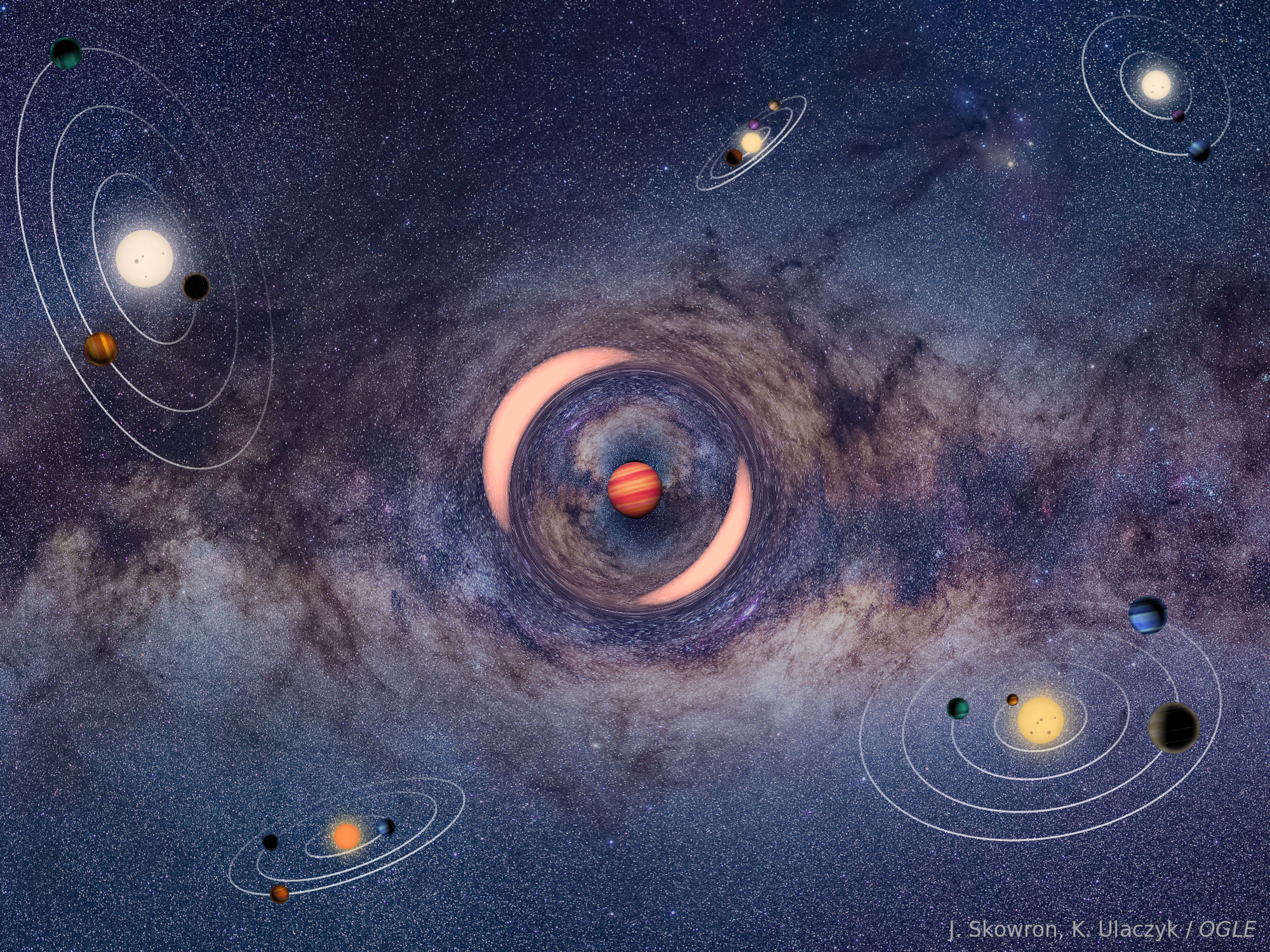 Artist’s impression of a free-floating-planet lensing the light of a distant source. Credit J. Skowron / OGLE
30 years ago, the first planets orbiting Sun-like stars were discovered, giving rise to a new field in experimental astronomy: the study of exoplanets. Over the past few decades, this field has developed at an astonishing pace, revealing ever more secrets of alien worlds and demonstrating that our Solar System is just one of many planetary systems in the Universe, and not necessarily a unique one. Until now, however, all known exoplanets were found in systems gravitationally bound to their host stars, orbiting around them. For many years, astronomers have realized that planets do not have to exist only in such bound systems. As a result of various processes, such as gravitational interactions with other planets during the formation of planetary systems or close flybys of neighboring stars, planets can be torn from their parent systems and ejected into interstellar space. These solitary planets, known as free-floating or rogue planets, then wander through the Milky Way without being tied to any star. Theoretical estimates suggest that their number could be very large, possibly even exceeding the number of planets bound to stars.
A difficult observation
How can such planets be discovered and proven to exist if they do not emit light and do not interact with a parent star? The answer lies in gravitational microlensing, a technique that allows astronomers to measure the mass of an object that bends light. In practice, microlensing occurs when the light from a distant star is bent and amplified by the gravity of a closer object, called the lens. Because this effect does not depend on how bright the lens itself is, the method can detect dark, non-luminous bodies, even if the planet itself emits no light at all. The duration of a microlensing event generally depends on the mass of the lens. For objects with
planetary masses, such events are very short, lasting only a few to several hours.
A few promising candidates for free-floating planets were identified in the last years. "Unfortunately, to directly determine a planet’s mass, astronomers need to know the distance to the lensing object", explains Laurent Eyer, co-author of the study. "From Earth-based observations alone, this is possible only in exceptional and extremely rare cases." As a result, these objects remained candidates: depending on their unknown distance, their masses could be larger or smaller, making it impossible to confirm that it was truly a planet rather than a more massive body, such as a brown dwarf.
Simultaneous observations
A breakthrough came with observations made on May 3, 2024. Using telescopes from the Korean KMTNet network (located in Australia, South Africa, and Chile), together with the OGLE telescope at the Las Campanas Observatory in Chile, astronomers recorded a short-lived gravitational microlensing event involving a bright star near the center of the Galaxy. According to convention, the event was named KMT-2024-BLG-0792/OGLE-2024-BLG-0516. Soon after the event ended, it became clear that the shape of the brightness variations matched predictions for microlensing caused by a free-floating planet. The event immediately joined the list of the most promising candidates for these evanescent objects.
Astronomers soon realized that the region of the sky where this microlensing event occurred was being observed at the same time by the European Space Agency’s flagship mission, Gaia, which between 2014 and 2025 carried out regular photometric observations of about two billion stars across the entire sky. Gaia was not designed to observe very short-lived events, but luckily, not only did the satellite observe this region during the brief, two-day-long event, but due to a particularly favorable orbital configuration, it collected as many as six photometric measurements within 15 hours, precisely during the most important moments, when the light amplification caused by the lensing object was strongest.
The simultaneous observations of the microlensing event KMT-2024-BLG-0792/OGLE-2024-BLG-0516 from Earth and from Gaia, situated at the Lagrange point L2 nearly two million kilometers from Earth, created a unique opportunity to measure the distance to the lens through the so-called microlensing parallax. The idea is similar to triangulation on Earth or to measuring distances to nearby celestial bodies by observing them from two different locations. Gaia’s photometric data were transmitted to Earth only in July 2024, at which point the Gaia Alert System team announced the event.
Confirmation of the planetary nature
An analysis of the microlensing data collected from the ground by the KMTNet and OGLE telescopes, together with the space-based data from Gaia, showed that the overall shape of the event as seen from both observatories, separated by about two million kilometers, was similar. However, the event recorded by Gaia occurred about two hours later than the one seen from Earth. This time shift made it possible to precisely determine the distance to the lensing object and the parameters of the microlensing event, which in turn allowed a direct and accurate measurement of its mass. The result showed that the object has a planetary mass of about 70 Earth masses – slightly smaller than the mass of Saturn in our own Solar System. No evidence was found for the presence of a possible host star within more than 20 astronomical units (the Earth–Sun distance) of the planet. "With very high confidence, the newly discovered object can therefore be considered unbound to any star - it is the first precisely “weighed” free-floating planet!", exclaims Laurent Eyer.
The discovery and direct mass measurement of a free-floating planet marks a major breakthrough in exoplanet research. It represents the first fully documented detection of an entirely new category of exoplanets: a vast and previously unexplored population of planetary objects whose study is essential for a complete understanding of how planetary systems form and evolve. This discovery will undoubtedly provide a strong impetus for further intensive research on this class of objects, with upcoming new facilities like NASA’s Roman Space Telescope, or the Chinese Earth 2.0 satellite, both to be launched in the years to come.
Link to the article in Science
1 Jan 2026