
Active Galactic Nuclei
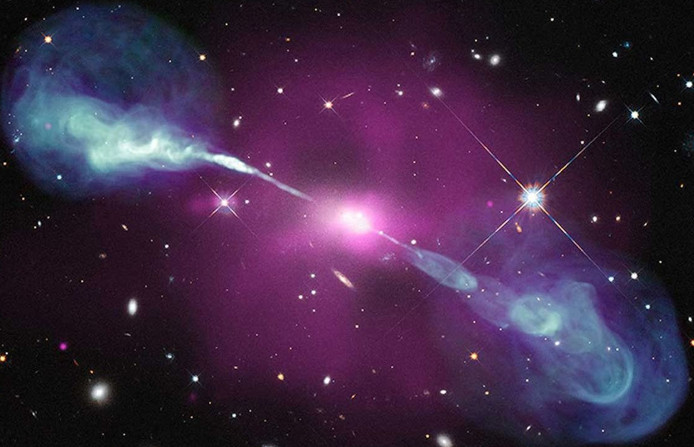
Most galaxies in the universe have a supermassive black hole (SMBH,) at their centre. If matter is actively accretted onto it, the galaxies are classified as `active' and they are dubbed as Active Galactic Nuclei (AGNs).
Both the group of Prof. Paltani and Ricci are researching around these objects with the aim of understanding of the physical processes and the geometry of accreting SMBHs, or active galactic nuclei (AGN).
In the group of Prof. Paltani, three complementary approaches are exploited to pioneer a physics-driven research.
- A large effort is made on the development of the RefleX simulation tool that can model the spectra and images of accreting objects surrounded by arbitrary distributions of matter. The code is then used to reproduce directly the observed population of AGN in X-rays.
- The group is involved in the Japanese XRISM mission, which provides high-resolution X-ray spectra that are important diagnostics of the distribution of matter around the black hole.
- The group also studies the evolution of the AGN population, e.g. using the FornaX survey of the Euclid Deep Field Fornax by XMM-Newton.
The group of Prof. Ricci is focussed on the study of accreting supermassive black holes, and work actively on several interconnected research themes:
- The circumnuclear environment of AGN. The group investigates the nature and evolution of the obscuring material surrounding SMBHs. Within the BASS survey, the group contributes to building the largest database of broadband X-ray and multi-wavelength properties of local AGN, including a significant population of heavily obscured sources, which will serve as a benchmark for studies of high-redshift sources. Future efforts will include the use of XRISM to study the physical and chemical properties of the circumnuclear gas through high-resolution X-ray spectroscopy. The group is also part of the AXIS and NewAthena science teams, which will advance studies of obscured AGN populations and their inner regions in the X-ray band.
- AGN accretion and variability. The group explores how SMBHs grow through accretion and how their activity varies over time, with a strong emphasis on time-domain surveys such as LSST. Their work includes the coordination of AGN follow-up and spectroscopic studies within the 4MOST/CHANGES collaboration, which will target LSST-identified AGN transients. These efforts are supported by ALERCE, a real-time event classification broker that uses machine learning to process transient alerts. The group is also investigating nearby super-Eddington AGN using X-ray, radio/mm and new IR (JWST) data to probe extreme accretion flows. In parallel, the group is working on the mm continuum emission from nearby AGN, to study the properties of the millimeter emission from hot plasma near SMBHs. In this context the group is contributing to AtLAST, a proposed next-generation 50-meter class single-dish mm/submm observatory.
- SMBH/galaxy co-evolution. Using ALMA and JWST, the group studies the interplay between AGN activity and star formation. Within the GATOS and GOALS collaboration, the group analyses gas flows and dust structures on scales of hundreds of parsecs, as well as the properties of luminous infrared galaxies in the local Universe