
Large scale structures
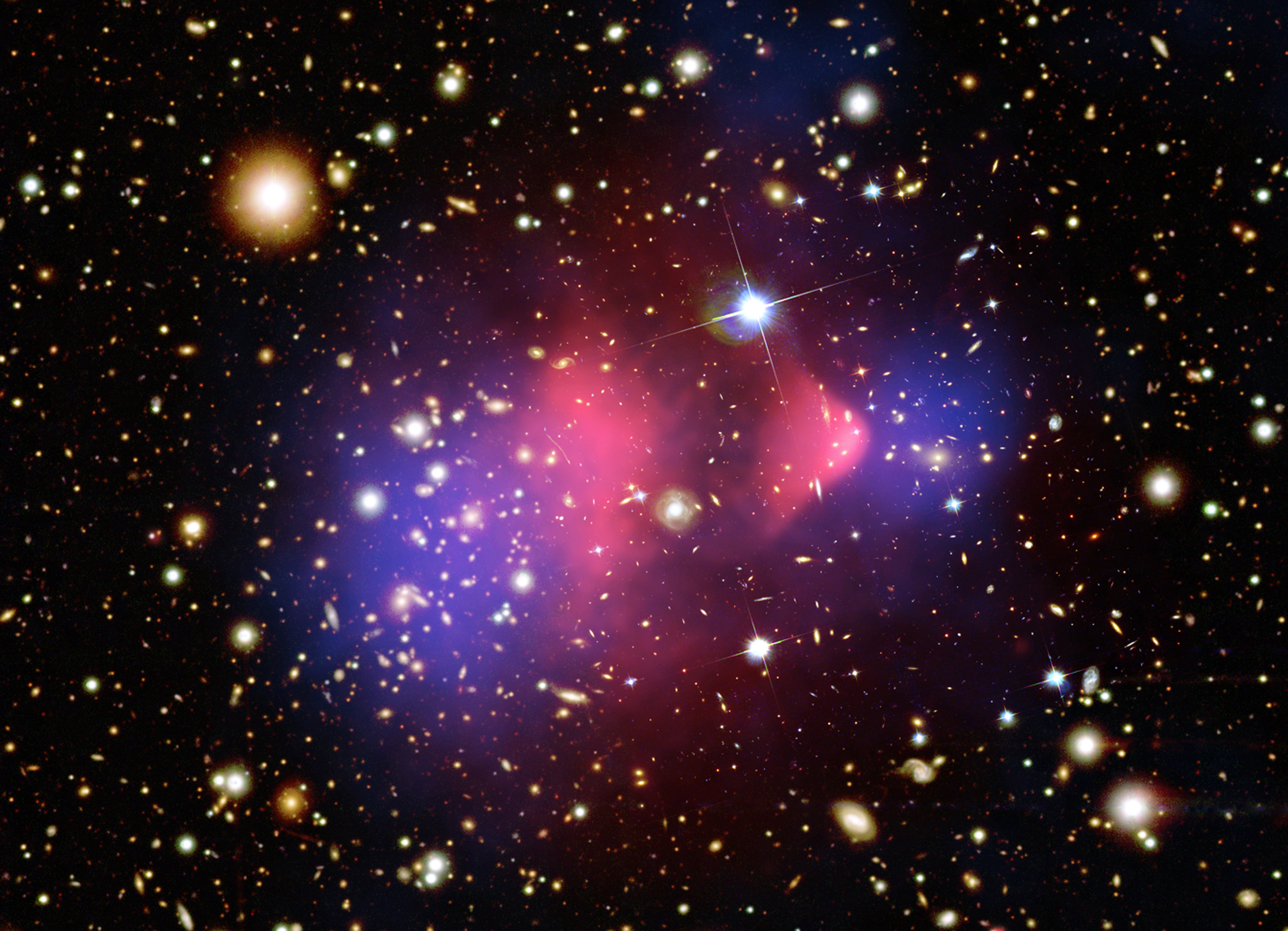
Most of the baryonic content of our Universe is in the form of a hot, dilute gas that fills the large-scale structure set by the dark-matter distribution. These hot baryons allow us to trace the properties of dark matter and to study how SMBHs affect the formation of galaxies and the star formation history of the Universe.
The group of Dr Eckert focuses on the study of the hot gas distribution in the Universe, in the most massive collapsed dark matter halos – galaxy clusters and groups. This is achieved mostly through observations of the extragalactic sky in the X-ray range and at millimeter wavelengths. This group also focuses on the study of the dark-matter distribution using weak gravitational lensing. They are exploiting the data from three recently launched space telescopes: eROSITA, Euclid, and XRISM.
The eROSITA mission has surveyed the entire sky at X-ray wavelengths providing a 20-fold increase in sensitivity compared to its predecessor ROSAT. The eROSITA data are used to trace the distribution of hot gas throughout the local Universe and to constrain the growth of structures in the Universe and the cosmological parameters.
The Euclid mission allows us to probe the three-dimensional distribution of matter through the weak gravitational lensing effect.
Finally, XRISM provides for the first time non-dispersive high-resolution spectroscopy in the X-ray range, providing us with invaluable information on the dynamics of the gas to understand how structures have grown to form the most massive systems we see today. They will jointly exploit these various datasets to probe the nature of dark matter and to understand the impact of SMBHs on the baryonic content of the Universe.