Behavioral, psychophysiological, and computational signatures of affective influences on information value learning
Dr. Yoann Stussi - FNS
 Abstract:
Today’s information overload poses key challenges: How do we decide when to seek information? This project examines how affective processes guide information-seeking by shaping how humans learn information value.
Project description:
Humans have a fundamental drive for knowledge. Coupled with the unprecedented volume of information in today’s digital landscape, this drive poses key challenges: How do we decide when to seek or avoid information? Why do we sometimes compulsively consume information even when it offers no benefit or makes us feel worse?
Information-seeking critically depends on how people value information. While individuals often seek information for its instrumental utility—guiding decisions and future actions—information-seeking is also driven by epistemic and emotional motives, such as satisfying curiosity, reducing uncertainty, and anticipating positive feelings. These motives highlight the central role of affective processes in shaping information value. However, the mechanisms by which people learn the value of information and how affective processes influence such learning remain unclear. Understanding these mechanisms is essential for better explaining both adaptive and maladaptive patterns of information-seeking.
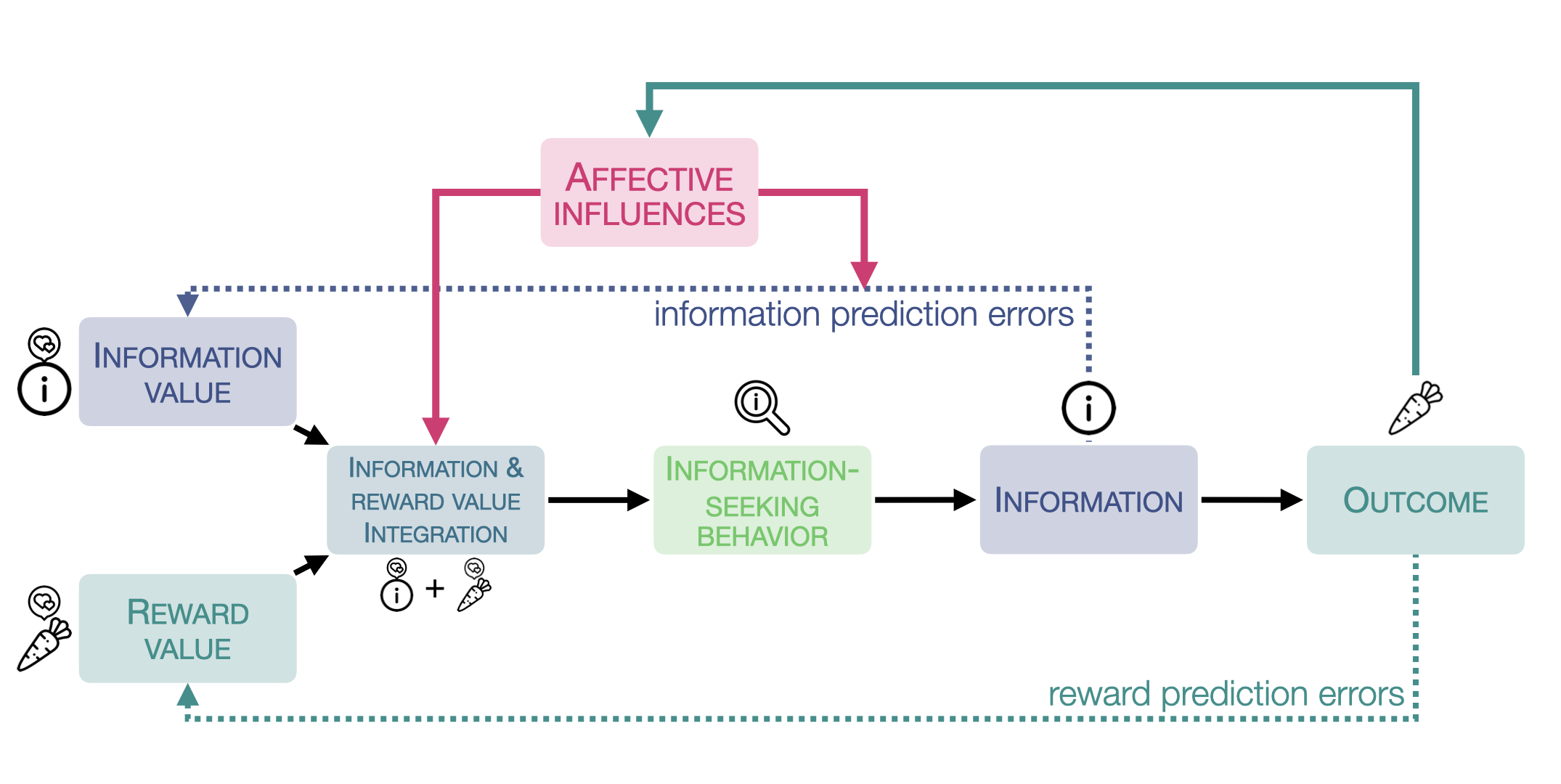
This project addresses this gap by systematically investigating how affective processes influence the way humans learn the value of information and how this, in turn, impacts information-seeking decisions. To achieve this, the project combines computational modeling based on reinforcement-learning algorithms with behavioral and psychophysiological methods to characterize:
1. How affective processes modulate learning from information prediction errors (i.e., discrepancies between expected and received information) and the integration of information value with reward value.
2. Affective responses to information using a multi-level, componential approach encompassing action tendencies, physiological responses, and subjective feelings.
3. The links between these processes and individual differences in affective traits and compulsive information-seeking behaviors.
By uncovering behavioral, psychophysiological, and computational signatures of affective influences on information value learning, the project aims to advance a dynamic mechanistic framework for understanding how affect and emotion shape information-seeking. In doing so, it seeks to provide an empirical foundation for targeting—and ultimately mitigating—compulsive information consumption, a growing challenge in the digital age.