
Home
PLEASE NOTE THE FOLLOWING / VEUILLEZ NOTER CE QUI SUIT
Smartphone/tablet users: For a better viewing experience, it may be useful to use the "Desktop View" (or "Computer View") option that you will find in the menu of your smartphone/tablet browser. It is also recommended to hold your phone or tablet in the horizontal (landscape) position.
Utilisateurs smartphone/tablettes: Afin de mieux visionner ces pages, il peut être utile d'utiliser la fonction "Version Bureau" (ou "Version pour Ordinateur") que vous trouverez dans le menu de votre navigateur de smartphone/tablette. C'est mieux de tenir le smartphone ou tablette on position horizontale (mode paysage).


 Martin Beniston was born in England in 1953 and holds three passports (Swiss, British, French).
After more than 40 years of academic life, he retired in the Summer of 2017, and is now an Honorary Professor of the University of Geneva, Switzerland. He is featured in Reuter's list of the "Top 1000 most influential climate scientists" (i.e., roughly the top 5% worldwide) in its ranking that first appeared in April, 2021.
After working in various institutes and countries around the world, including the Max-Planck-Institute for Meteorology in Hamburg and ETH-Zurich, he was appointed one of the vice-chairs of the IPCC (Intergovernmental Panel on Climate Change, recipient of the 2007 Nobel Peace Prize) in the 1990s. He subsequently became professor and head of department at the Swiss Universities of Fribourg (1996-2006) and Geneva (2006-2017).
Among his numerous research endeavours, he initiated and coordinated a major European project ("ACQWA", 2008-2013) dedicated to mountain water resources in a changing climate. The project involved around 100 scientists from 10 countries in Europe, Central Asia, and South America. He was also the scientific leader of the "Planet Solar DeepWater" expedition in the North Atlantic in 2013, using the world's largest solar-powered vessel, the Swiss "Tûranor Planet Solar" to undertake unique measurements at the ocean-atmosphere interface.
He has been active on research committees in EU countries as well as Canada, and has acted as editor-in-chief and editorial board member of several international journals. He was a member of the scientific council of ENGIE, the international energy concern, and invited to Hong Kong University to assess one of their Master's programs.
In 2000, he was elected to the Academia Europea, the European Academy of Science.
These pages provide a short overview of his research and academic career in the domains of atmospheric and climate science.
These MENU OPTIONS allow to explore the website:
 Né en Angleterre en 1953, Martin Beniston possède trois passeports (suisse, britannique et français).
Après plus de 40 ans de carrière, il prend sa retraite à l'été 2017 et est depuis Professeur honoraire de l'Université de Genève en Suisse. Il figure parmi les 1000 scientifiques du climat les plus influents, soit le top 5% mondial, selon le classement de l'agence Reuters qui a été publié pour la première fois en avril 2021.
Après avoir travaillé dans divers instituts et pays autour du monde, entre autres l'Institut Max-Planck de Hambourg et l'ETH-Zurich, il est nommé de 1992-1997 l'un des vice-présidents du GIEC (Groupe Intergouvernemental pour l'étude de l'Evolution du Climat, lauréat du Prix Nobel de la Paix en 2007). Il est ensuite nommé professeur et directeur d'institut des universités suisses de Fribourg (1996-2006) et de Genève (2006-2017).
Ses recherches comprennent entre autres le développement et la coordination d'un grand projet européen ("ACQWA", 2008-2013) sur les ressources hydriques dans un climat qui change, regroupant une centaine de chercheurs en Europe, en Asie Centrale et en Amétique du Sud. En 2013, il est le leader scientifique de l'expéditon "Deepwater" dans l'Atlantique nord, utilisant le plus grand bateau solaire du monde, le navire suisse "Tûranor Planet Solar", utilisé pour effectuer des mesures inédites à l'interface océan-atmosphère.
Il siège sur des comités scientifiques dans des pays de l'UE et au Canada, et a été éditeur-en-chef et membre du comité de lecture de plusieurs revues scientifiques internationales. Il a été membre du conseil scientifique du consortium d'énergie international ENGIE et invité à la Hong Kong University pour évaluer un de leurs programmes de master.
En 2000, il est élu membre de l'Academia Europea, l'Académie européenne des Sciences.
Ces pages web présentent un bref aperçu de sa carrière académique dans les domaines des sciences de l'atmosphère et du climat.
Les MENUS suivants permettent d'explorer le site:
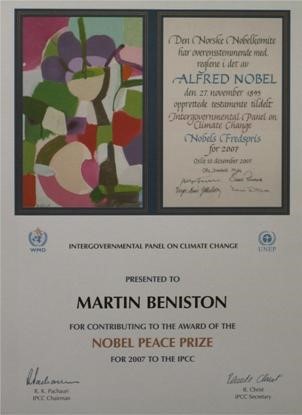
The 2007 Nobel Peace Prize was awarded to the IPCC (Intergovernmental Panel on Climate Change). This certificate acknowledges the contributions of its most active members.
Le Prix Nobel de la Paix 2007 a honoré le GIEC (le Groupe Inter-gouvernemental pour l'étude de l'évolution du climat) . Ce certificat témoigne de la contribution de ses membres les plus actifs.
