
Searching for New Physics with Machine Learning
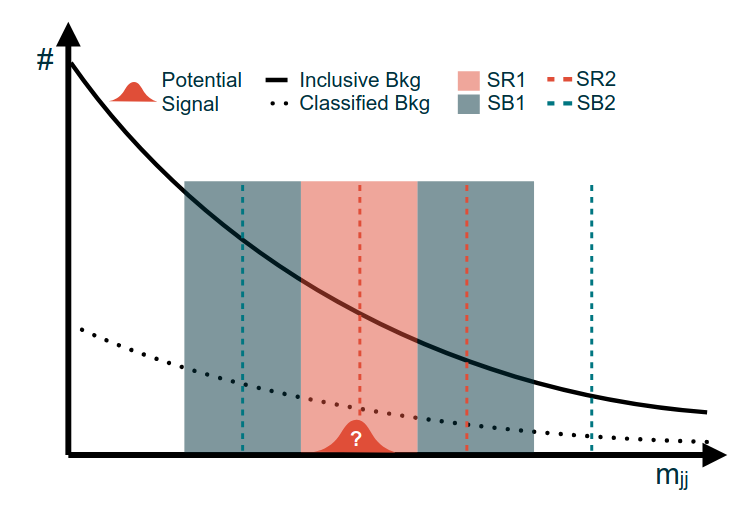
In high-energy physics, the number of potential scenarios for physics beyond the Standard Model far exceeds the capacity of dedicated searches. The goal is to increase the discovery potential by moving beyond narrow model optimization and by systematically exploring the search space to fully exploit the depth-breadth trade-off of new physics searches. Developing effective methods for such searches requires balancing generalisation and sensitivity while also
addressing robustness and computational costs.
Our work focuses on developing search strategies that improve these aspects while making analysis workflows more reproducible and easier to reinterpret. We address the challenges of these searches by using modern machine-learning techniques, including advanced reconstruction methods, pseudo-data template generation (e.g. TRANSIT), and signal detection (e.g. Cluster Scanning, Strong CWoLa). This will maximize short- and long-term progress in high-energy physics discovery, and help to assess the coverage of signal space and ultimately guide us towards the optimal next search to maximize our knowledge gain.
References
- Strong CWoLa: Binary Classification Without Background Simulation https://arxiv.org/abs/2503.14876
- TRANSIT your events into a new mass: Fast background interpolation for weakly-supervised anomaly searches https://arxiv.org/abs/2503.04342
- Weakly supervised anomaly detection for resonant new physics in the dijet final state using proton-proton collisions at s√=13 TeV with the ATLAS detector https://arxiv.org/abs/2502.09770
- Robust resonant anomaly detection with NPLM https://arxiv.org/abs/2501.01778
- Accelerating template generation in resonant anomaly detection searches with optimal transport https://arxiv.org/abs/2407.19818
- Cluster Scanning: a novel approach to resonance searches https://arxiv.org/abs/2402.17714
- Improving new physics searches with diffusion models for event observables and jet constituents https://arxiv.org/abs/2312.10130
- The Interplay of Machine Learning--based Resonant Anomaly Detection Methods https://arxiv.org/abs/2307.11157
- CURTAINs Flows For Flows: Constructing Unobserved Regions with Maximum Likelihood Estimation https://arxiv.org/abs/2305.04646
- FETA: Flow-Enhanced Transportation for Anomaly Detection https://arxiv.org/abs/2212.11285
- CURTAINs for your Sliding Window: Constructing Unobserved Regions by Transforming Adjacent Intervals https://arxiv.org/abs/2203.09470
Researchers involved
- Tobias Golling
- Stephen Mulligan (https://arxiv.org/abs/2503.14876)
- Ivan Oleksiyuk (https://arxiv.org/abs/2402.17714, https://arxiv.org/abs/2402.17714)
- Theresa Reisch