
Conférence du Prof Michel Rickhaus
LUNDI 20 avril 2026 à 17h30
Université de Genève – Bâtiment Science II
30 quai Ernest-Ansermet Genève
Auditoire A-150
Télechargez l'abstract
Flat from Curved: How Bending Molecules Can Lead to Extraordinary Order.
In a typical self-assembly setting, a core is decorated by suitable sidechains that induce supramolecular polymerization. While this approach has led to spectacular assemblies, the core has almost always been seen as a rigid platform from which to append functionality rather than as an integral, defining part of the unit. The core mission of our group is to investigate the role that molecular topography – the form– plays in the assembly process. With emphasis on synthetic solutions, we construct π-topographies that we think to be beneficial to supramolecular polymerization.
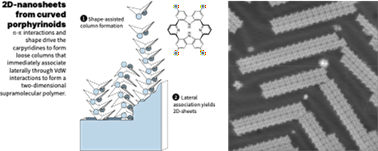 We were recently able to demonstrate that indeed, a simple negatively curved porphyrinoid building block (about 2 nm wide, including sidechains) can instigate order on the micrometer(!) scale with astonishing aspect ratios (about 1:1000:100’000) and edge-definition by simple dropcasting (toluene). The paradigmatic shift is that these soft matter monolayered sheets/flakes are not held together by conventionally employed non-covalent interactions like hydrogen-, ionic, or coordinative-bonding. By using curved π-systems, we succeeded in driving these assemblies to high order mainly by π–π interactions and demonstrated that rational tailoring yields different tertiary structures. I will share key (form)-concepts for π-systems to act as information carriers for shape-assisted self-assembly, insights into our current systems and how these represent the first steps into controlled supramolecular synthesis.
20 avr. 2026