
Extreme Universe
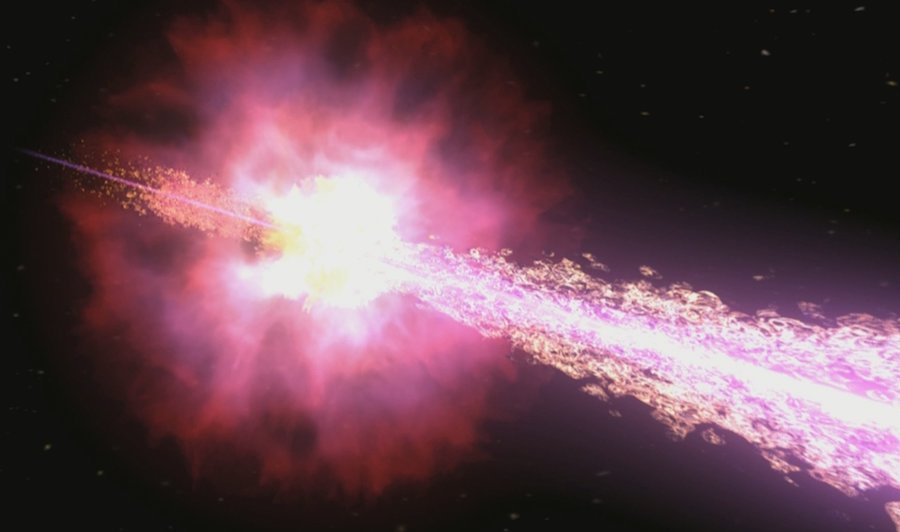
The ‘Extreme Universe’ axis studies objects in the Universe that are extreme in terms of their densities, gravities, magnetic fields, or energies.
These phenomena often result in the emission of high-energy electromagnetic radiation in the X-ray and gamma-ray bands. The objects studied are stellar remnants such as neutron stars and stellar-mass black holes, but also much larger objects, from supermassive black holes (SMBH) to clusters of galaxies, as well as the entire Universe. Neutron stars and black holes are often associated with other astrophysical ‘messengers’ such as cosmic rays, neutrinos, and gravitational waves. The axis is also at the forefront of data science and big data, with huge and complex data sets and a generalized usage of deep-learning-based methods. Numerical simulations also play an important role in our research activities. The different groups are strongly involved in large observational projects, in particular Euclid, LISA, and NewAthena, with significant contributions to the development of the Euclid and NewAthena missions, as well as to that of the THESEUS mission, which is still under selection.