

Open Access
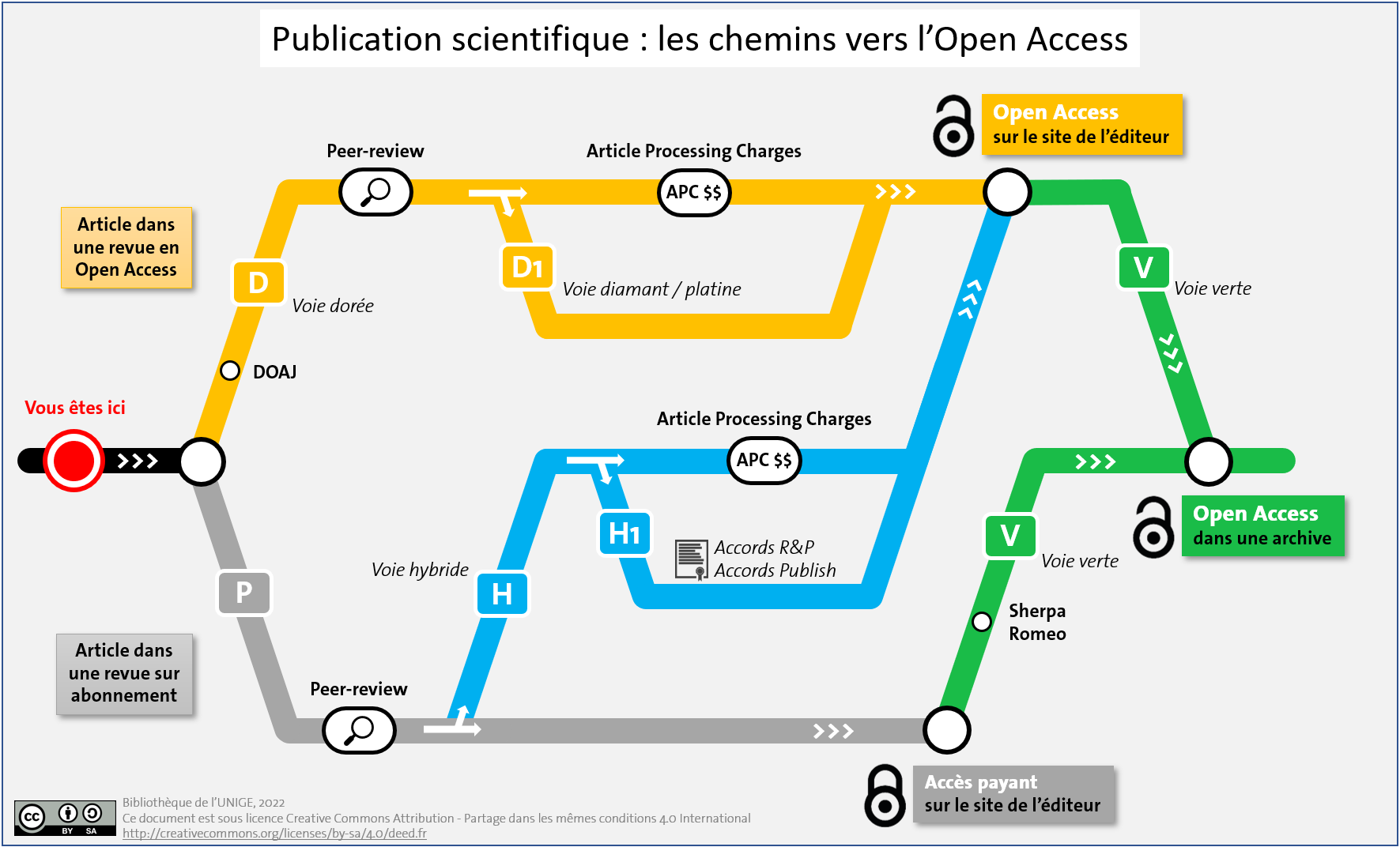
There are several ways to make a publication freely accessible, often illustrated as roads or paths :
- The Gold Road consists of publishing the results of one's research in an Open Access journal or in an Open Access book. Access to the document is immediate and free for all on the publisher's website.
The author is sometimes charged publication fees (Article Processing Charges or APC; Book Processing Charges or BPC), which can often be covered by the Swiss National Science Foundation (SNSF), or even by the UNIGE's publication fund under certain conditions.
100% Open Access journals are listed in the Directory of Open Access Journals (DOAJ), and books in the Directory of Open Access Books (DOAB).
- The Green Road consists of publishing in a journal (often subscription-based) and depositing a freely accessible copy of the article in a repository of one's choice. Researchers at UNIGE are required to deposit their publications in the UNIGE Open Archive, and, where applicable, in a disciplinary repository (arXiv, PMC, etc.)
- The hybrid model consists of publishing one's article in a subscription journal and paying an additional fee to make the article available in Open Access.
Open Access roads illustrated:
In the Gold Road publishing:
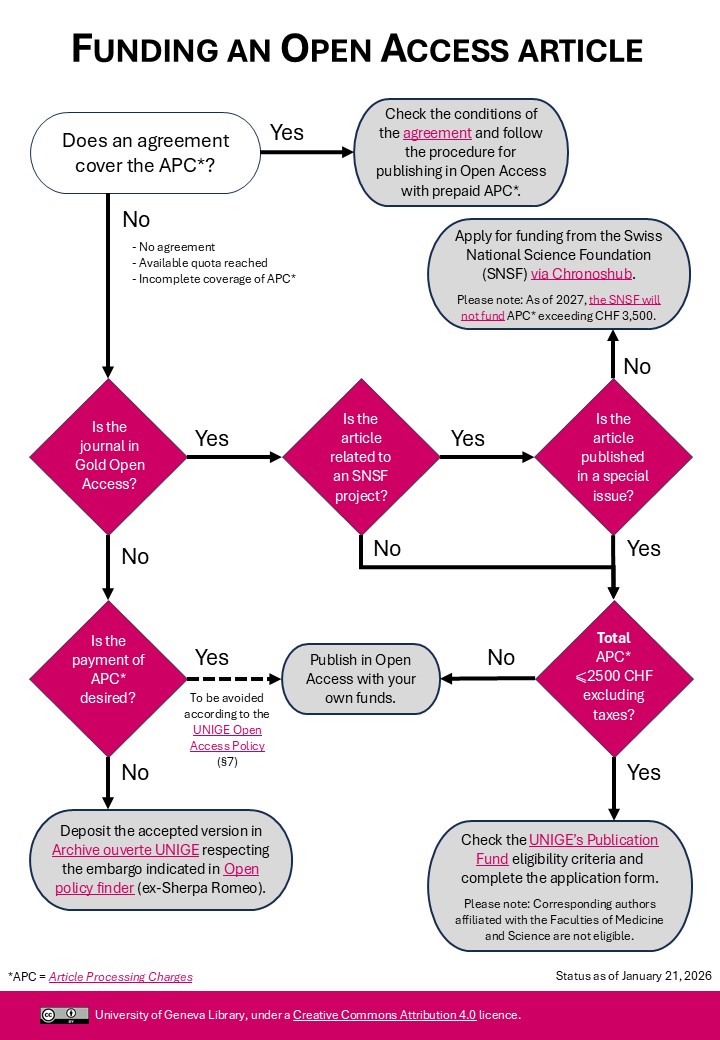
- If the article is funded by the SNSF, the full amount of the APC will be covered.
- If the article is not funded by the SNSF, the UNIGE Publication Support Fund may be applied for to cover publication fees (APCs) of up to CHF 2,500.
For subscription-based journals from certain publishers, Read & Publish agreements allow members of the University to both access articles and publish them in Open Access, at no additional cost (hybrid route).
The Open Policy Finder (formerly SHERPA/RoMEO) usually makes it possible to determine whether a publisher imposes an embargo and/or restrictions on which version of the article may be shared (preprint, AAM = author accepted manuscript, VoR = version of record).
You can also use the Journal Checker Tool to find out about a journal’s Open Access publishing options and possible funding.
The flowchart below presents the different funding options for publishing an article in Open Access.
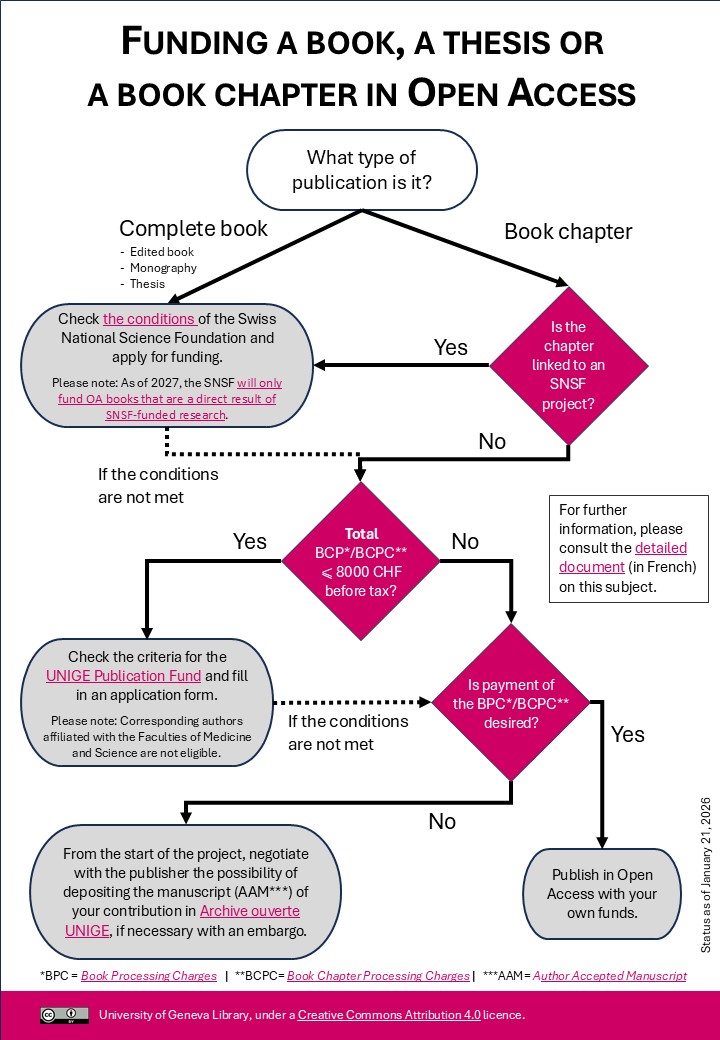
Open Access book publication charges may be covered by the SNSF, under certain conditions, even if they do not result from research funded by the SNSF.
For book chapters, the research must have been supported by the SNSF for it to contribute to the publication costs.
For both types of publications, the UNIGE Publication Support Fund may be available, under certain conditions, if the SNSF does not fund the publication.
For further information, please consult the dedicated document (in French only) on this topic.
Applying a Creative Commons licence to your work (article, figure, dataset) facilitates its dissemination and reuse.
By choosing a Creative Commons licence, you indicate in advance which forms of reuse are authorised, without the need for users to seek your prior permission.
Creative Commons licences are modular and combine several elements that define the conditions under which reuse is permitted. These elements are represented by standardised pictograms, making the terms of reuse clear and easily identifiable.
 |
This work is licensed under a Creative Commons licence. |
 |
Attribution (BY) — You must give appropriate credit, provide a link to the licence, and indicate if changes were made. |
 |
ShareAlike (SA) — If you remix, transform, or build upon the material, you must distribute your contributions under the same licence as the original. |
 |
NonCommercial (NC) — You may not use the material for commercial purposes. |
 |
NoDerivatives (ND) — You may not distribute modified material, including partial dissemination, adaptations, or translations of the work. |
The “Choose a License” tool will help you select the licence combination that best suits your situation by asking you to answer a few specific questions.
Please note before applying a licence to a work:
-
You must be the copyright holder in order to apply a Creative Commons licence to a work. Your co-authors must also agree.
-
The material must qualify as a work within the meaning of copyright law (Art. 2 of the Copyright Act, CopA).
-
Some raw datasets do not meet these criteria; it is therefore not possible to apply a Creative Commons licence to them.
-
Creative Commons licences are not suitable for software.
Another tool is available to help you choose an appropriate licence for software or datasets.
Further questions?
The Unpaywall tool allows you to find legally available Open Access versions of scientific articles. This extension can be installed directly on your browser (Firefox or Chrome).
When viewing a paywalled article on a publisher’s website or in a database, if a freely accessible version exists, it will be indicated by a green button on the right side of the screen. By clicking this button, you will be taken directly to the Open Access version hosted on one of the repositories or Open Access platforms available worldwide.
See the extension description (in french) for more details.
Training sessions