Meetings
Workshop on Computational Earth
12-17 October 2025, Elba Island, Italy.
Application to geothermal systems and crustal structures with passive seismic methods using machine learning.
In the framework of the SNF Sinergia project MIGRATE: A Multidisciplinary and InteGRated Approach for geoThermal Exploration, link
We are happy to invite you to the workshop co-organised by the University of Geneva, the CNR of Florence and the Hes So of Geneva on:
Computational Earth:
Integrating geology, seismic tomography and machine learning

The workshop will take place at the Tenuta Ripalte, Elba Island, Italy, link from the 12th of October to the 17th of October 2025. The workshop is free and only living and transportation costs will have to be covered by the attendees. Note that the Swiss National Science Foundation supports the workshop with a financial program that has already being secured. Early career scientists and colleagues attending from low-income countries are welcome to apply to such a grant before the 15th of August. To do so please contact us () and we will inform you about the documents to provide. The costs for the living costs are reported below the agenda of the workshop.
WORKSHOP PROGRAM
Monday 13 October: Imaging with ambient noise
8:30 – Matteo Lupi: Intro of the school, MIGRATE and scope of the workshop
8:50 – Francisco Munoz Burbano: Principles of Ambient Noise Tomography and introduction of the dataset for the afternoon sessions.
9:10 Ivan Cabrera Perez: Exploiting the EGF: Nodal Ambient Noise Tomography and Ambient Noise Attenuation Tomography
9:40 Onkgopotse Ntibinyane: Ambient Noise Tomography of Botswana for Crustal Imaging
9:55 Javier Tortosa: Posteruptive investigation of La Palma plumbing system with ambient noise.
10:10 Ali Riahi: Body-wave seismic noise tomography and P-to-S velocity ratio for geothermal reservoir exploration
10:40 Coffee and posters
11:30 Martina Raggiunti: Application of Nodal Ambient Noise Tomography from dense networks in the western Alps
11:45 Brook Keats: Geophysical imaging of the Paeroa Fault: Insights from a dense nodal seismic array
12:00 Douglas Stumpp and Singh Gurjeet: Challenges of Nodal Ambient Noise Tomography (picking etc)
AFTERNOON HANDSON SESSION
We will begin with an introduction to some fundamentals of machine learning models used in segmentation problems for automatic curve-picking tasks. The content will cover: convolutional neural networks, UNet model, as well as evaluation methods and quantitative metric analysis.
Afterwards, a hands-on session will be followed, where:
a) You will be introduced to the task of manual dispersion curve picking, where your results will be compared with a pretrained segmentation model.
b) You will then learn how to train a segmentation model from scratch, covering insights of the full training process, from pre-processing, selecting appropriate objective functions and tracking relevant performance measures and evaluating results.
Participants are expected to bring their own computer with MATLAB (R2024b or later) and Python installed. Moreover, think about having plug adapter(s) for Italy (Types C, F and/or L).
We will provide training and evaluation datasets. However, the participants can also bring their own dataset, which should conform to the structure of the datasets that we will use in the exercises and demos. If you are considering doing so, please contact at least two weeks in advance for more information and to coordinate preparing your data (i.e. network configuration/coordinates, cross-correlation functions and group/phase velocity dispersion images). The data structure is also accessible at the pretrained segmentation model repository (https://github.com/ShaoboYang-USTC/DisperPicker/tree/master/data/TestData), which we encourage you to take a look at prior to this session.
Tuesday 14 October: Velocity changes and generative models
8:30 – Thomas Lecoq: Seismic Noise Characterization in Belgium: Spatial and Temporal Variations for Interferometry and Velocity Monitoring Applications
9:00 – Laure Brenot: Attenuation and velocity changes to understand the transient behaviour of volcanoes
9:15 - Henriette Bakkar: Tracking Hydrothermal and Magmatic Processes at Rincón de la Vieja volcano using continouos seismic monitoring analysis
9:30 – Mohit Bokaryia: Transient velocity structure linked to premonsoon and post-monsoon conditions.
10:00 – Tesfaiwhet Abraha: Coda quality factor and peak delay in Aluto-Langano geothermal field
10:15 Andy Nowacki: Testing geothermal hypotheses beneath Corbetti, Ethiopia, with 3D P- and S-wave seismic tomography
10:30 Coffee and posters
11:30 Alexandros Kalousis: Introduction to generative models/SBI
12:00 – Nils Schaetti: From group and phase velocity maps to AI-divern inversion methods. Architecture and workflow
AFTERNOON HANDSON SESSION
We will show how to tackle the depth inversion problem and go from group velocities to depth velocity profiles. This will be followed by a hands-on session that will be split in two parts :
a) We will introduce some of the existing depth inversion methods of ANT and review Monday’s hands-on session results. Some of these results will be employed to generate the S-wave velocity model(s) that you will explore and with which we will engage discussions on picking quality, inversion techniques, and geophysical interpretations.
b) We will continue by demonstrating the use of machine learning methods for depth inversion, where you will be introduced to simulation-based inference (SBI) with a focus on the use of machine learning models and generative models to support SBI tasks. We will demonstrate two types of models:Wednesday
- Standard predictive models that provide a point estimate of the depth curve.
- Conditional generative models that model the distribution of the depth velocity profiles given.
Both model types will be trained and evaluated on data created by simulators.
Participants are expected to bring a laptop with MATLAB (R2024b or later) and Python installed. Example datasets will be provided. Attendees with access to their own synthetic or measured dispersion curves are encouraged to bring them for experimentation and comparison.
For questions or to share your data in advance, please contact
Wednesday 15th of October
We offer two alternatives for those interested in geology and geohpysics
Geological fieldtrip: We will show the exhumed analogue of the Larderello geothermal system. The fieldtrip will stop at the cooled granitic plutons, and will continue at the aureola, fluid-bearing fault systems and fluid-mineralised shallow deposits.
AFTERNOON HANDSON SESSION
For geophysicist: Retrieval of body waves from seismic ambient noise
An alternative workshop on the extraction of body waves from ambient noise will be conducted by Dr. Riahi as an alternative to the geological fieldtrip.
The session section will focus on the retrieval of body waves from seismic ambient noise. We will start with introducing the theory and techniques for separation of the P- and Rayleigh waves.
The session is divided into two parts:
- Morning: we will practically develop a script to estimate the empirical Green’s function (EGF) using an example dataset that will be shared. By the end of the morning, you will have extracted the P-wave in a common-offset view.
- Afternoon: we will continue the process by filtering the empirical Green’s functions and estimating the 3D phase arrivals.
Please bring your computer with both MATLAB and Python installed, as well as Anaconda for managing the required packages. Contact for questions.
Thursday 16 October: Seismicity, fluid flow and geological models: application of machine learning to geothermal challenges
8:30 – Juan Porras Loria: From raw data to high-resolution earthquake catalogues aided by Artificial Intelligence
9:00 – Luigi Passarelli: Characterizing earthquake swarms in natural and induced settings
9:30 – Rossella Fonzetti: Machine-learning vs semi-automatic seismic catalogs: a new catalog for the L’Aquila 2009 earthquake sequence.
9:45 – Saeed Soltani: Earthquake Location and Magnitude Estimation Using Advanced Machine Learning Techniques
10:00 - Hayleiy Woodrich: Reevaluating the 2008-2009 Yellowstone Lake Seismic Swarm with Deep Learning
10:15 - Genny Giacomuzzi - Trans-dimensional tomography with machine-learning data at Campi Flegrei caldera
10:30 Coffee and posters
11:30 - David Naranjo Hernandez - Overcoming Urban Noise and Model Uncertainty for Monitoring Geothermal Energy: First Evidence of Microseismicity in South Holland.
11:45 - Josef Vlcek: Computational Earth: Integrating geology, seismic tomography and machine learning.
12:00 – Brandon VanderBeek: Mapping fracture networks in geothermal systems through probabilistic anisotropic P-wave tomography: An application to the Hengill Geothermal Field (Iceland).
12:15 - Ali Masihi - temporal seismic velocity changes associated with earthquake swarms and magmatic intrusions
12:30 - Hugo Cruz Himenez: Constructing a 3D model for the Mexico city Basin
AFTERNOON HANDSON SESSION
In this session we will analyze seismicity around geothermal systems. Participants are expected to bring a laptop with Matlab, Python and jupyter-notebook installed. Example datasets will be provided. Please contact and for further information.
Required python libraries:
- Numpy
- Scipy
- Matplotlib
- Obspy
- Pandas
- Scikit-learn
Living costs:
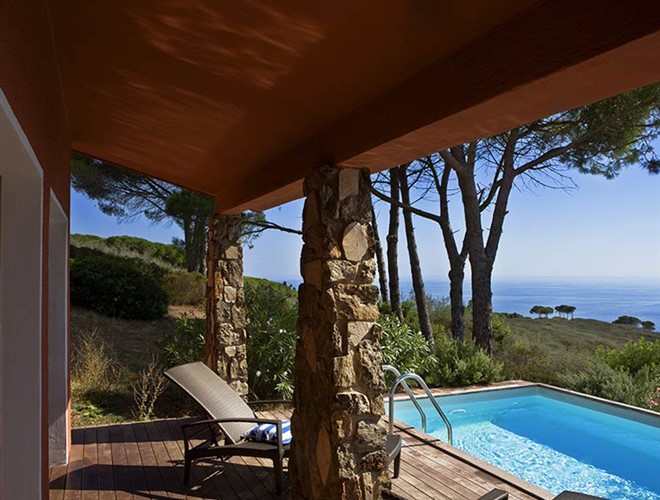
The organising commission set up special prices with La Tenuta le Ripalte, if booked in advance (i.e. before 15th of August with deposit). If cancellation up to September 14, refund can be provided.
The costs that have been secured for subscribers are the following:
45 Euros per person in all the available accommodations (these include glamping, room, hotel and apartments). Please visit the website of Le Ripalte link and inform us about your preferred choice. We will organise the booking together.
35 Euros for breakfast and dinner (i.e. 80 Euros per day half pension)
15 Euros for a buffet lunch (i.e. 90 Euros per day for full pension).
The SINERGIA project MIGRATE began in November 2022 and brings together the Machine Learning Team lead by Prof. Alexandros Kalousis at the Hes.so, the Group of Crustal Deformation and Fluid Flow (CDFF) in our Department lead by Prof. Matteo Lupi and Dr. Domenico Montanari from the IGG of Florence, Italy.
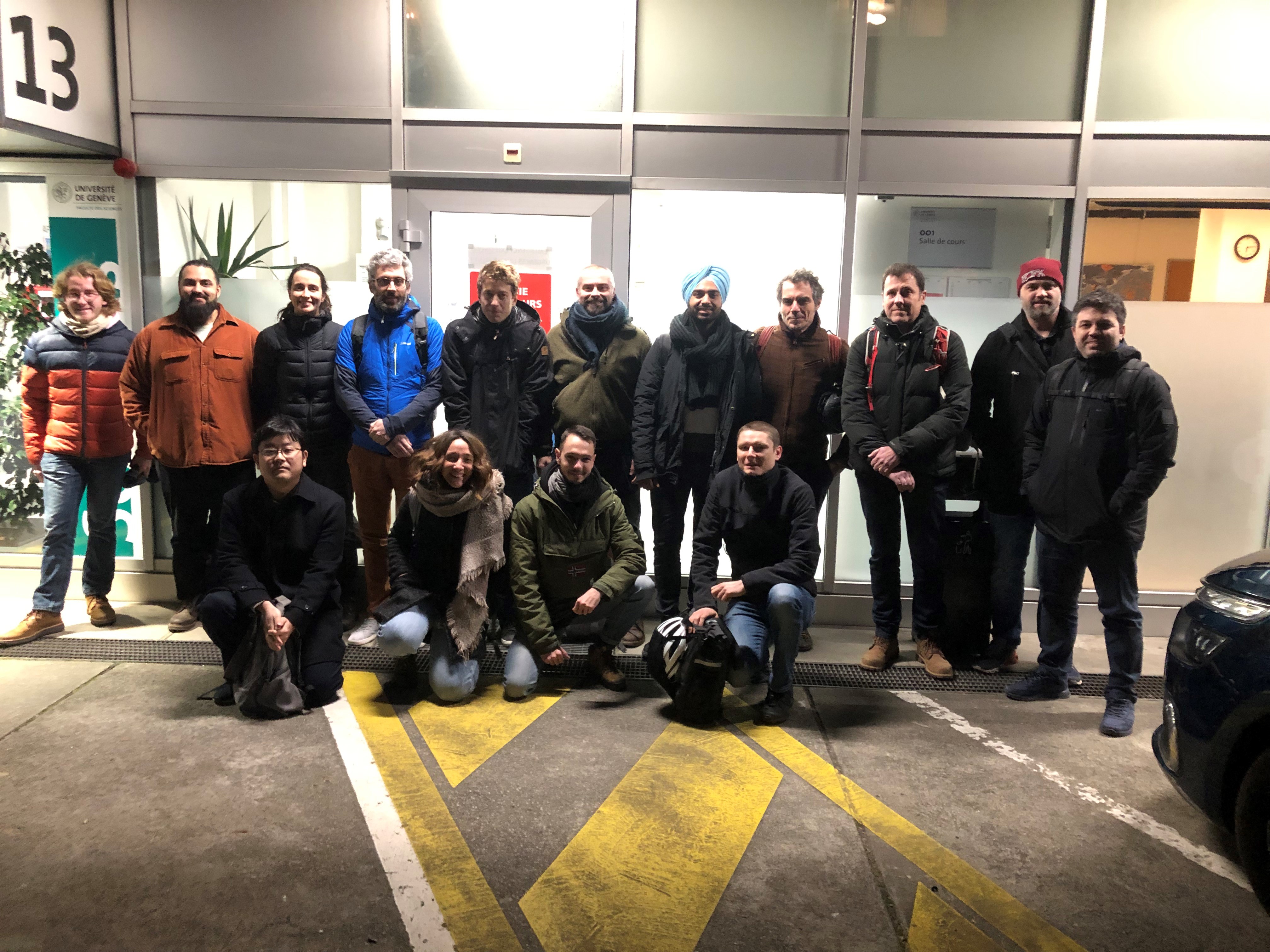
On the 2nd of February we had our first gathering. The day was marked by exciting presentations and lots of scientific questions unfolded.