
Strategic Foresight Summer School: Navigating Uncertainty for Decision-Makers
- Junior professionals in strategy, policy, planning, innovation, or consulting who need to make long-term decisions under uncertainty
- Public sector practitioners working on strategic planning and policy development
- Master's students from diverse disciplines seeking transferable skills for navigating complex futures
- Anyone who needs to think systematically about futures in their work – from healthcare to education, from sustainability to technology
COURSE DESCRIPTION
Master the Art and Science of Futures Thinking
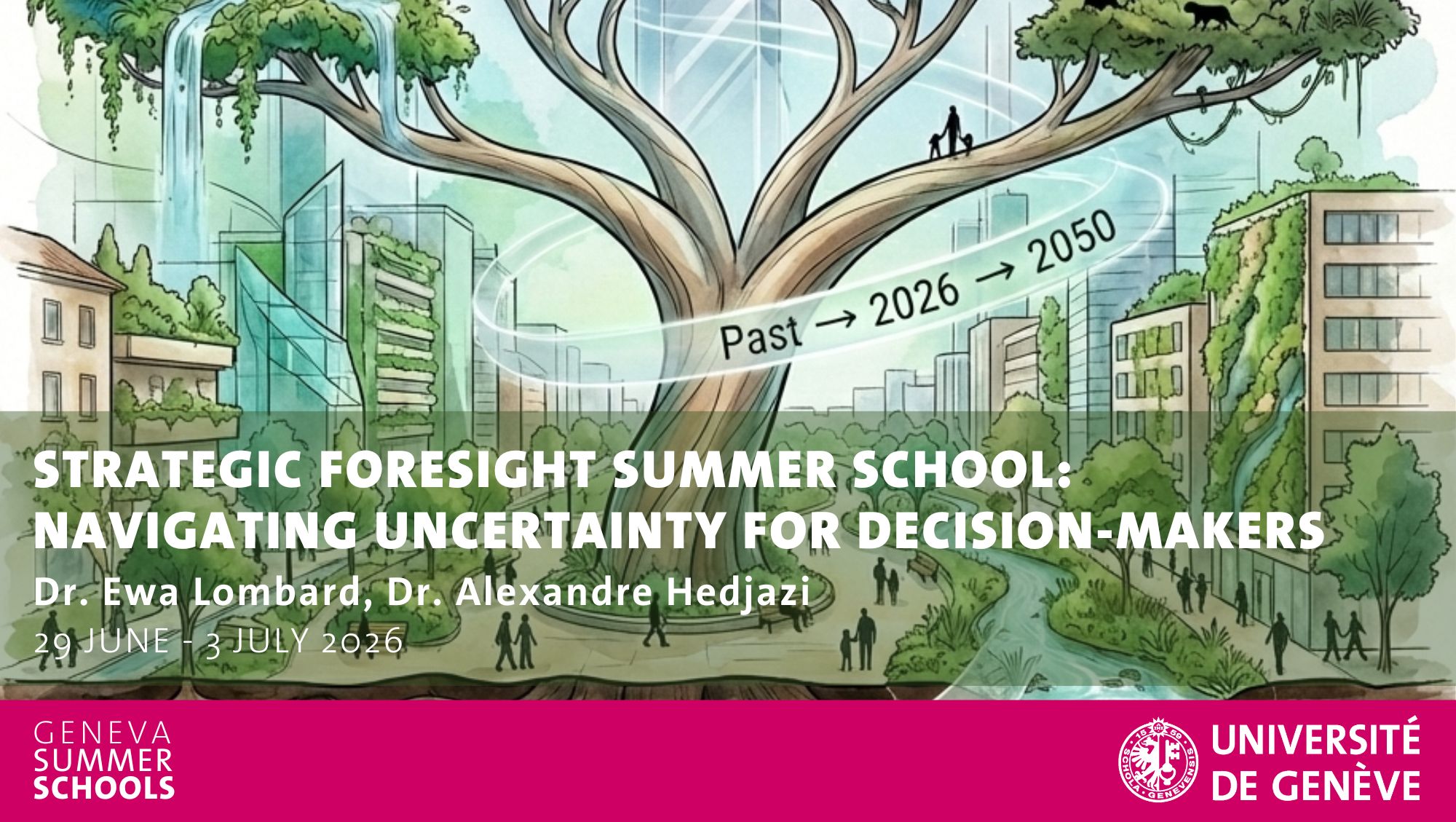
Join us for an intensive five-day strategic foresight workshop where you'll learn professional methodology for navigating uncertainty and shaping possible futures. Through hands-on application to a real local challenge – resilient cities in the Geneva context – you'll master essential foresight tools that can be applied to any complex, long-term strategic question.
Why Strategic Foresight? Why Now?
We face unprecedented uncertainty across every domain: technological disruption, climate change, demographic shifts, geopolitical instability, social transformation. Traditional planning approaches – based on prediction and single-future assumptions – no longer work.
Strategic foresight offers a structured methodology for:
- Navigating deep uncertainty without pretending to predict
- Exploring multiple plausible futures systematically
- Identifying robust strategies that work across different scenarios
- Building organizational and personal capacity to anticipate and adapt
- Making better long-term decisions today
This summer school equips you to:
- Apply a complete foresight toolkit to any strategic challenge
- Facilitate scenario planning processes in your organization
- Integrate futures thinking into strategic planning and decision-making
- Build stakeholder alignment around long-term strategy
- Communicate about uncertainty and futures effectively
Whether you're a student building career skills or a professional expanding your strategic toolkit, these methodologies will transform how you approach any long-term challenge.
No prior experience with foresight methodologies required—just a commitment to rigorous thinking about uncertainty and futures.
WHAT YOU’LL LEARN
Core Foresight Competencies
Future Thinking & Scenario Planning
Move beyond linear predictions to explore multiple plausible futures. Learn to use horizon scanning, the futures triangle, and scenario matrices to navigate uncertainty with confidence.
Systems Thinking for Complex Challenges
Master tools like PESTEL frameworks, stakeholder analysis, and futures wheels to understand how urban nature systems interconnect with social, economic, and technological factors across time.
Strategic Decision-Making Under Uncertainty
Develop the capacity to make robust decisions that work across multiple future scenarios. Apply wind tunneling and SWOT-TOWS analysis to stress-test strategic actions.
Collaborative Sensemaking
Build collective intelligence through team-based scenario development, peer review sessions, and stakeholder engagement—essential skills for addressing wicked problems.
Adaptive Communication
Learn to translate complex future scenarios into compelling narratives and actionable recommendations for diverse stakeholders, from policymakers to community members.
ASSESSMENT & DELIVERABLES
Your work will be evaluated on three components:
- Team Project Presentation (poster format)
Present your 3-4 scenarios and strategic recommendations to clients and peers - Active Participation
Engage fully in workshops, field visits, and peer learning activities
Note: This is a pass/fail evaluation. Responsible use of AI tools is permitted for team projects (with full attribution), but not for individual reflective essays.
It is the sole responsibility of the student to secure approval from their home institution for the transfer or recognition of academic credit for this course, in accordance with our Terms & Conditions.
Junior Professionals: CHF 1,100
External students (*): CHF 900
UNIGE students (*): CHF 250
(*) Junior professionals, PhD and Master’s students from all walks of life who need to think systematically about futures in their work – from healthcare to education, from sustainability to technology.
Application deadline: 15 April 2026
Dr. Ewa Lombard (Course Director)
Senior Researcher at LUCID Lab (Laboratory for Uncertainty, Collective Intelligence and Decision-Making), University of Geneva, and member of the WEF Global Foresight Network. Dr. Lombard specializes in the psychology of futures thinking.
Dr. Alexandre Hedjazi (Co-Course Director)
Expert on the future of cities, Dr. Hedjazi brings extensive experience in urban foresight and will co-facilitate key workshop activities throughout the week.
Distinguished Guest Speakers:
The program will feature practitioners from public and private foresight and sustainability sectors, sharing their practical experience and engaging directly with your projects. Confirmed speakers will be announced closer to the program date
Your Real-World Case Study
You'll work in small teams (3-4 people), applying the complete foresight methodology to a local challenge provided by a Geneva public sector stakeholder. This year's case study focuses on resilient cities, but the methodology you learn can be applied to any strategic domain – from healthcare transformation to educational futures, from technological innovation to environmental policy.
Your team will develop 3-4 plausible scenarios for 2050, complete with strategic recommendations. This hands-on practice with a real client ensures you learn by doing, not just by listening.
Daily Structure:
Day 1 (June 29) - The Past: Historical Foundations
- Morning: Course introduction, futures thinking foundations, the Polak game
- Afternoon: Project scoping, stakeholder analysis, layered historical analysis
- Guest speakers from public sector and foresight community
Day 2 (June 30) - The Present: Scanning the Horizon
- Morning: Field visit with key stakeholders, backcasting exercises
- Afternoon: Horizon scanning workshop, emerging issues analysis, PESTEL frameworks
Day 3 (July 1) - The Future I: Scenario Development
- Morning: Introduction to scenario methods, 2×2 matrix technique, review inspiring scenario reports
- Afternoon: Draft your scenarios, future stakeholder analysis, futures wheel mapping
- Guest: Scenario expert
Day 4 (July 2) - The Future II: Strategic Implications
- Morning: SWOT-TOWS strategic analysis, wind-tunneling your recommendations
- Afternoon: Design "day in the life 2050" future personas, develop your preferred scenario narrative
- Guest speakers from private sector
Day 5 (July 3) - Transformation: Presentation & Reflection
- Morning: Team presentations (poster session format) to project stakeholders
- Afternoon: Peer review, debrief, collective reflection on future consciousness
- Guest speakers from local governance sectors