Geneva's Chalk Talks
A glimpse into the maths behind the blackboard
The Geneva Chalk Talks series gives visibility to the work being done within the Section of Mathematics in a visual and direct way accesible to all mathematicians.
Each edition features a researcher sharing a snapshot of their work, right where ideas often start: at the blackboard.
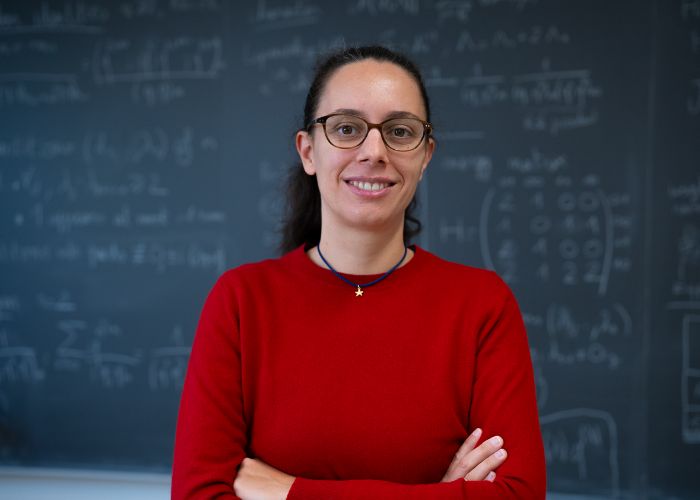
Jehanne Dousse
The blackboard displays several aspects of the theory of partition identities, a topic that arose in combinatorics but has strong and interesting connections with other topics such as number theory, representation theory, commutative algebra or mathematical physics.
A partition of a positive integer n is a non-increasing sequence of positive integers whose sum is n, the partitions of 3 being (3), (2,1) and (1,1,1). A partition identity is a theorem asserting that for all n, the number of partitions of n satisfying some conditions equals the number of partitions of n satisfying some other conditions.

Anders Karlsson
This Chalk Talk highlights applications of a discrete Gaussian in various areas, following a 2025 paper by Chinta, Jorgenson, Karlsson, and Smajlović. The topics include heat diffusion, Bessel functions, local limit laws, determinants of Laplacians, zeta functions, trigonometric sums, and volume formulas.

Marcos Mariño
The theory of resurgence is a method to make sense of factorially divergent series, which appear frequently in physics and in mathematics.These two examples, in knot theory and enumerative geometry, show how the ideas of resurgence, which originated largely in physics, not only have applications in mathematics, but may provide a unified framework for understanding quantum geometry.

Andras Szenes
This Chalk Talk displays some famous formulas linking Theoretical Physics and Enumerative Geometry. They mark some of the first in a remarkable series of contacts between the two subjects.

Bart Vandereycken
The blackboard explains a method called the dynamical low-rank algorithm (DLRA), used to simplify costly calculations involving large matrices or tensors, such as those in physics and engineering. DLRA works by focusing on low-rank approximations, which are simpler yet accurate representations of the original data. This makes solving equations faster and more efficient. Collaborations with colleagues in physics and applied mathematics improved DLRA, extending it to tensor networks and preserving important physical properties like energy. Recent advancements explore its use for stiff problems and improving its efficiency using randomization techniques, making DLRA a powerful tool for modern scientific computing.
With the support of: