
Vermifiltration pour le traitement des eaux usées domestiques
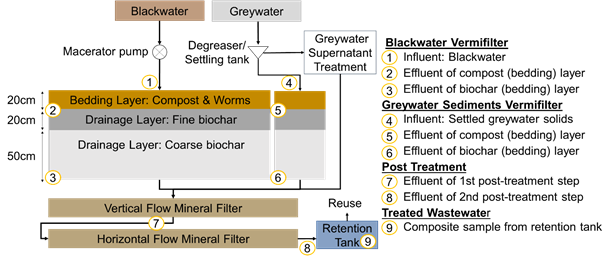
Due to low investment and operational costs, chemical and energy independence, and a high potential to contribute to circular wastewater management practices, vermifiltration is a globally relevant wastewater treatment solution. Despite its potential, insufficient knowledge of the full-scale performance and the absence of guidelines for optimal design and operation impede vermifiltration from being widely implemented. This study analyzed the performance of two full-scale vermifilters treating domestic blackwater and greywater sediments in winter and summer in Switzerland. For the first time, the operating conditions of both vermifilters were determined empirically, where the blackwater vermifilter observed 4 times lower hydraulic loading rates, though 10 times larger nitrogen loading rates than the greywater sediments vermifilter. Both vermifilters demonstrated the ability to maintain high removal efficiencies for organics and solids (>75 % for BOD5, COD, and TSS), though nutrient removal was lacking (<30 % for TN and TP). The design and operation used in the full-scale vermifilters are, in general, recommendable, as no clogging was observed, and the performance of the vermifilters did not vary with season. In addition, with post-treatment, the effluent complied with discharge standards 100 % of the time. Insights into optimal design and operation include separate urine treatment, increased vermifilter depth, and alternative and intermittent feeding regimes. Such modifications would likely decrease the post-treatment requirements, spatial footprint, and investment costs. Overall, the results of this study conclude that when employing favorable design and operation conditions, vermifiltration is a relevant, reliable, and resilient wastewater treatment solution for both urban and rural areas worldwide.
Coppens, K., Strande, L., et Stoll, S., 2025, Performance analysis and impact of operating conditions on the treatment capacity of two full-scale vermifilters: Journal of environmental management, v. 391, p. 126328.
8 juil. 2025