
Geneva's Chalk Talks - Marcos Mariño
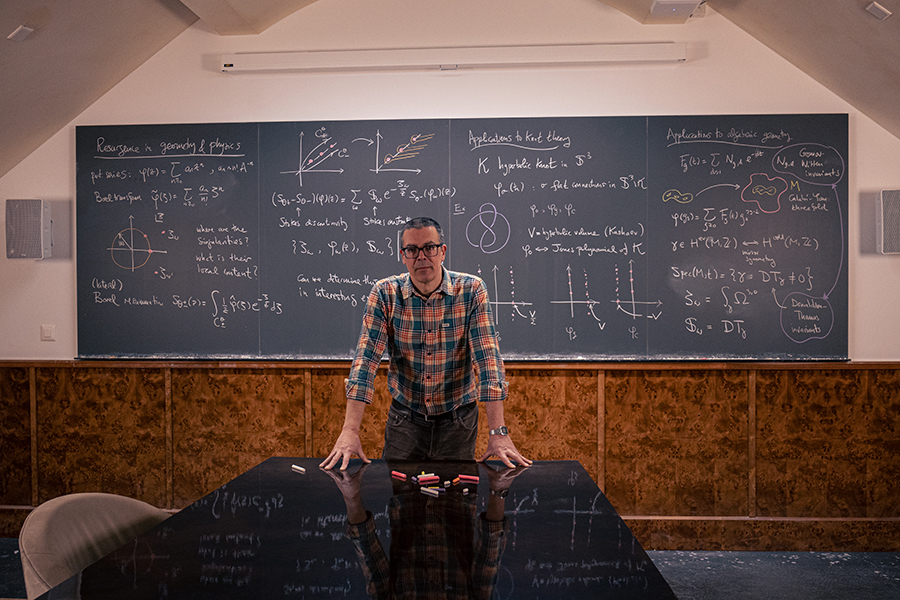
The blackboard illustrates the theory of resurgence and two recent mathematical applications.

The theory of resurgence is a method to make sense of factorially divergent series, which appear frequently in physics and in mathematics.
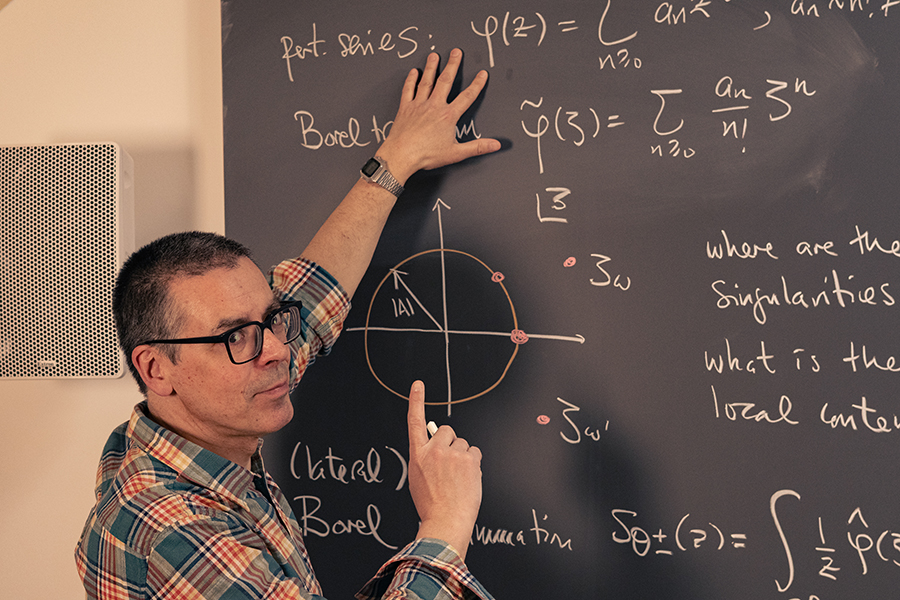
First, one defines the so-called Borel transform of the factorially divergent series, which is a convergent series but typically develops singularities upon analytic continuation to the complex plane. Each singularity gives rise to a new divergent series and to a complex number, called a Stokes constant. The singularities, their positions, their associated series, and their Stokes constants together form what is called the resurgent structure of the original series, which is the object we aim to determine. In physics, resurgent structures encode information about other sectors of the theory which are invisible in the perturbative expansion, such as instantons or renormalons. One way of detecting resurgent structures is to consider the Laplace transform of the Borel transform, known as the Borel resummation of the original series. These resummations jump across rays which pass through singularities. These jumps, also called Stokes discontinuities, encode the information associated with these singularities.
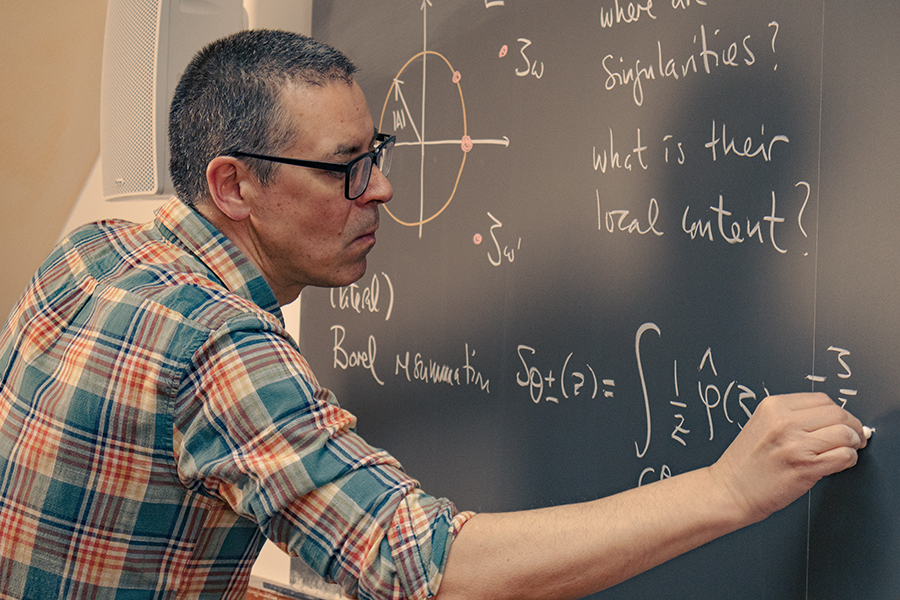
These basic notions of the theory of resurgence are illustrated in the first half of the blackboard.
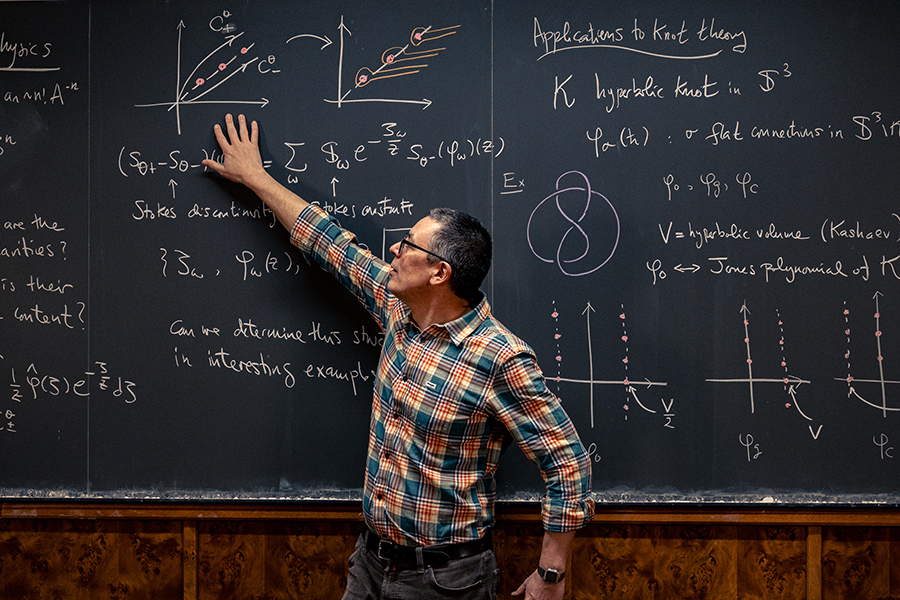


The second half of the blackboard presents two applications of this theory. The first one is in quantum topology. Quantum topologists can define invariants of knots in the form of perturbative series. One of these series, sometimes called the Habiro series, and denoted by φ0 on the blackboard, can be constructed from the colored Jones polynomial of the knot. The resurgent structure of these series has been an active subject of research in recent years, and one can formulate for example a resurgent version of Kashaev's volume conjecture: the resurgent structure of φ0 contains a singularity located precisely at the value given by the hyperbolic volume of the knot. For simple knots, like the figure-eight knot, there are conjectural descriptions of the resurgent structure for the family of perturbative series considered in quantum topology. In this case, the Stokes constants are infinite families of integers which can be regarded as new topological invariants of the knot, although some of them are related to the so-called index of the knot.

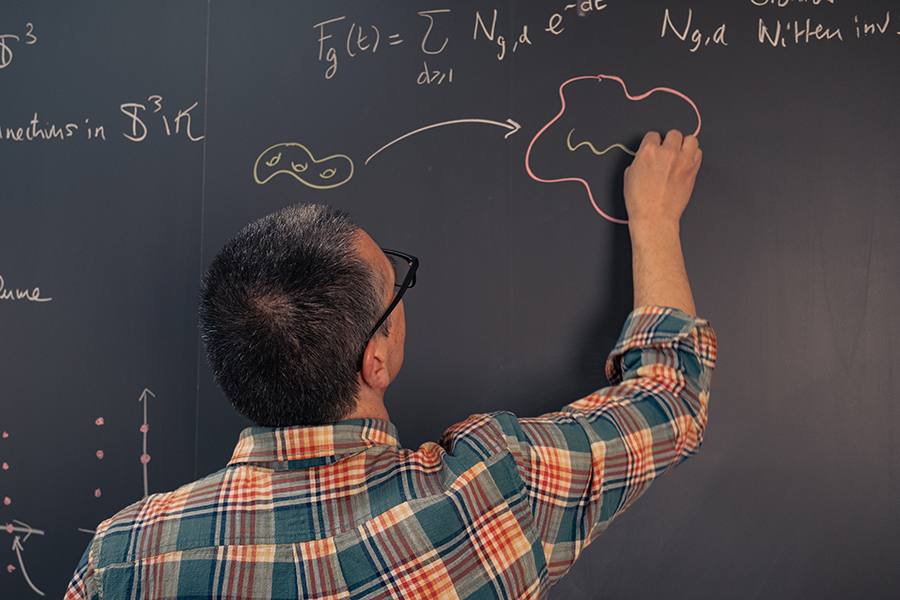
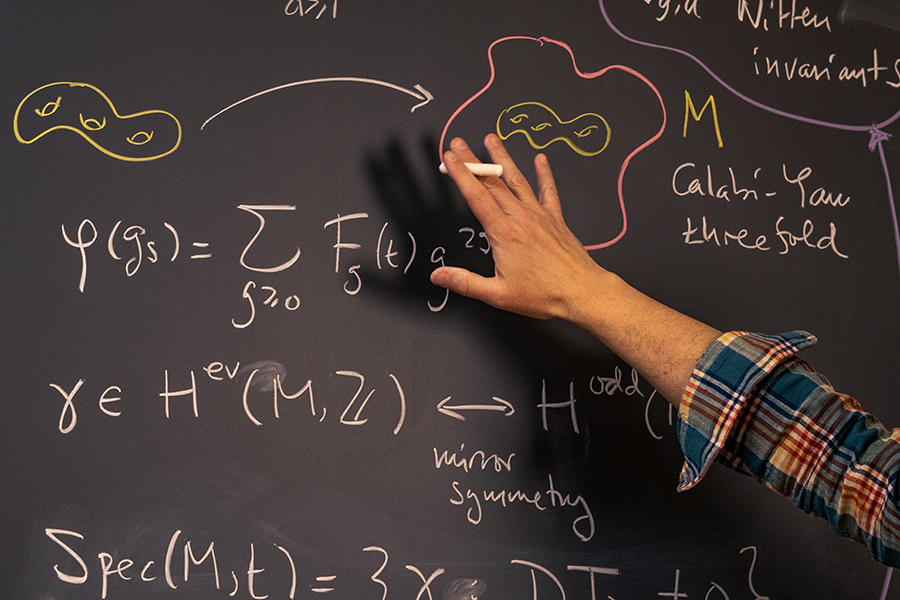
The second application is in a different area, the enumerative geometry of algebraic varieties called Calabi--Yau manifolds. The famous Gromov-Witten invariants counting curves in these varieties can be encoded in a sequence of functions Fg(t), where g=0,1,2,... is roughly the genus of the curve, and t denotes parameters specifying the geometry of the variety. This sequence of functions is factorially divergent, and one can ask what is its resurgent structure. This structure has been conjectured recently, with the surprising claim that the Stokes constants appearing there are also integers. They are expected to coincide with the so-called Donaldson-Thomas invariants of the variety, an a priori different set of topological invariants.
These two examples show how the ideas of resurgence, which originated largely in physics, not only have applications in mathematics, but may provide a general framework for understanding both quantum invariants of knots and enumerative invariants of algebraic varieties.
Marcos Mariño was born in Santiago de Compostela (Galicia, Spain) in 1970. He got a PhD in theoretical physics in the university of his hometown, and was a postdoctoral researcher at Yale, Rutgers and Harvard from 1997 to 2003. He was also a junior staff at CERN from 2003 to 2007. His research focuses on the interface between geometry and quantum field theory and string theory, and on mathematical approaches to non-perturbative physics. He is professor of mathematical physics at the University of Geneva and has a joint appointment in the Department of Mathematics and in the Department of Theoretical Physics.
Images: Vittorio Tranchina (Service Audiovisuel, UNIGE)