
Connexin Controls Blood Stem Timing
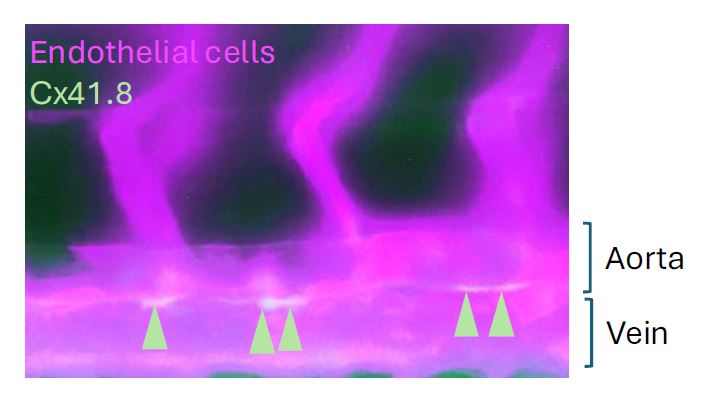
© BERTRAND/UNIGE
Connexin 41.8 governs timely haematopoietic stem and progenitor cell specification
Haematopoietic stem and progenitor cells (HSPCs) derive from a subset of endothelial cells (ECs), known as haemogenic ECs, by the process of endothelial-to-haematopoietic transition (EHT). Although many factors involved in EHT have been elucidated, we still have a poor understanding of the temporal regulation of this process. Mitochondrial-derived reactive oxygen species (ROS) have been shown to stabilise the hypoxia-inducible factor 1/2a (Hif1/2a) proteins, allowing them to positively regulate EHT. Here, the authors show a developmental delay in EHT and HSPC induction in a gap junction mutant, connexin (cx)41.8 (orthologous to mammalian CX40), in zebrafish. In mammalian cells, CX40 has been shown to localise to the mitochondria. They demonstrate that Cx41.8 is important for the correct temporal generation of mitochondrial ROS, which stabilise the Hif pathway, allowing for the subsequent specification of the haemogenic endothelium. Taken together, their data indicate that Cx41.8 governs the correct temporal induction of HSPCs.
Full article: https://doi.org/10.1242/bio.062118
WHY IS IT IMPORTANT?
Blood stem cells, which give rise to all types of blood cells, are born from special blood vessel cells in the embryo through a process called endothelial-to-haematopoietic transition (EHT). This study found that a protein called Connexin 41.8 (similar to human CX40) is crucial for the timing of this transformation in zebrafish. Connexin 41.8 helps generate tiny signals from mitochondria, called reactive oxygen species (ROS), which are needed to turn on key genes that start blood stem cell development. Understanding this timing could help scientists improve methods to grow blood stem cells in the lab, potentially revolutionising treatments for blood diseases and supporting regenerative therapies.
4 Jul 2025