Research data management
About the Data Project…
The Data Project began at the Faculty of Medicine at the end of 2024. Its purpose is to bring together a community of researchers to reflect on the faculty’s strategy and practices for research data management. The Project’s objectives are to identify the tools and approaches needed to facilitate and optimize data management, promote and support the implementation of institutional policies at the faculty level to ensure compliance with legal requirements, and help create an environment conducive to good management and valorization of research data while meeting competitiveness requirements, nomenclature and semantic standards, and integrating advances in artificial intelligence.
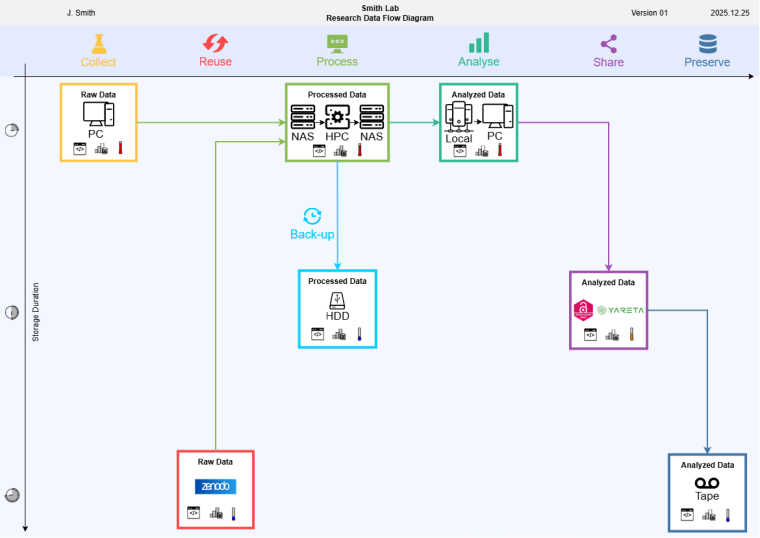
The Data Project has identified three focus areas addressing challenges in research data management: education in data management, data storage, and data sharing. Three working groups were established to study these topics and propose simple and effective measures to address these challenges. The working groups produced a set of recommendations to facilitate and improve data management, and a series of deliverables to support researchers and platforms in their daily data management activities. In addition, the Data Project offers a new tool to help researchers reflect on the lifecycle of data within their laboratories: the Research Data Flow Diagram (RDFD).
Education in Data Management
The "Education" working group aimed to identify actions to improve the knowledge and skills of staff and students at the Faculty of Medicine in data management. The group first analyzed training needs for data management and use, and mapped existing faculty and institutional courses, resources, and services. Based on this work, the group proposes the following actions:
- Improve visibility and ease of access to information by centralizing all available services, courses, and resources on the institutional ResearchData website.
- Develop a dynamic tool on the ResearchData website to allow the university community to quickly and simply identify the main data management tools and associated trainings.
- Implement a mandatory e-learning course (in partnership with HUG) to raise users’ awareness of rights and obligations regarding data management.
- Integrate the basics of the data lifecycle into undergraduate and doctoral training.
By organizing these actions around a common, coordinated approach, the working group proposes a structured, operational vision for developing skills in data management, protection, and valorization for all Faculty audiences.
The "Education" working group produced three framework documents:
- Mapping of entities and services involved in data management
- Teaching guide for data management for the Faculty of Medicine
- Recommendations and proposed actions to implement in the short, medium, and long term
Data Storage
The "Storage" working group aimed to analyze research data storage practices (with a strong focus on active data during research), and to recommend approaches and tools for improved data management. First, the group mapped the storage solutions available to research groups of the Faculty and then created a visual to help researchers quickly identify the recommended services and infrastructures according to the stages of the data lifecycle. The group also produced a glossary of storage terminology and acronyms, so all Faculty staff share a common vocabulary. Additionally, the group analyzed legal recommendations and obligations regarding retention periods for research data.
The working group also designed the Research Data Flow Diagram (RDFD). This tool is primarily intended for PIs and faculty platform managers. The RDFD has three purposes:
- A reflection instrument to assess the research data lifecycle in the lab / platform
- A decision-support document to implement better data management strategies
- A tool to identify needs for improvement in practices and infrastructure
The "Storage" working group produced three framework documents:
- Recommendations for storage services and infrastructures according to the stages of the research data lifecycle
- Glossary of storage terminology and acronyms
- User guide for the Research Data Flow Diagram
Data Sharing
The "Sharing" working group aimed to examine data-sharing practices (in particular the active data during research) and to propose a set of best practices and tools that enable collaborative work while ensuring data security. The group seeks to promote data sharing by encouraging better data formatting using recognized standards and persistent identifiers. It also reviewed existing collaborative workspace solutions and the feasibility of sharing data within those environments. To improve data visibility and encourage reuse, the group compiled an inventory of discipline-specific data repositories relevant to the research groups of the Faculty.
The group also engaged with the "Data Management" working group established by HUG and the Wyss Center as part of the joint Artificial Intelligence Hub. The purpose of this collaboration is to participate in planning a shared workspace between HUG and various external partners.
The "Sharing" working group produced four framework documents:
- Inventory of standards specific to the research activities of the Faculty
- List of persistent identifiers
- List of collaborative workspaces relevant to the types of research conducted within the Faculty
- Inventory of discipline-specific data repositories in the fields of medical research
Contributors to the Data Project:
Composition of the working groups (in alphabetical order, with the working group leaders’ name underlined):
- Education:
Romain Cartoni, Christophe Combescure, Monica Didier, Noémi Duperron, Daniel Huber, Christophe Lamy, Patrick Meraldi, Floriane Muller, Olivia Peila, Julien Prados, Caroline Samer, Dimitri Van De Ville
- Storage:
Valérie Barbié, Eric Beuchotte, Laurent Bouysset, Hugues Cazeaux, Sébastien Courvoisier, Sami El-Boustani, Arnaud Didierlaurent, Alexis Hervais-Adelman, Daniel Huber, Christophe Lamy
- Sharing:
Valérie Barbié, Camilla Bellone, Eric Beuchotte, Philippe Bijlenga, Laurent Bouysset, Hugues Cazeaux, Sébastien Courvoisier, Arnaud Didierlaurent, Timothy Frayling, Aurélie Kamoun, Floriane Muller, Douglas Teodoro
- Project manager:
Johann Bosson