
Understanding the resilience of healthcare systems
A book edited by Karl Blanchet, Director of the Faculty of Medicine's Centre for Humanitarian Studies, draws on the analyses of more than 30 specialists from around the world to explain how healthcare systems adapt and transform when facing health crises, climate change or large-scale armed conflict. Published by The MIT Press, this book is a unique resource for anyone - managers, politicians, academics or students - concerned with these issues to ensure that healthcare systems continue to fulfil their essential mission. Available from 9 September 2025.
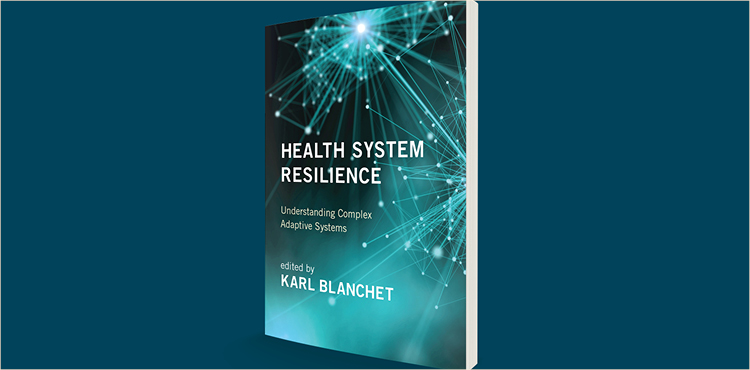
© MIT Press
In a world where health, economic and climatic crises follow one another so quickly, a crucial question arises: how can healthcare systems not only survive the shocks, but emerge stronger? "Healthcare systems are complex, dynamic systems that are constantly adapting to changes in their environment," says Karl Blanchet. "This book brings together the world's leading experts, who draw on the theories of systems thinking and the science of complexity to decipher the dynamics at work and offer practical tools to those responsible for managing these events.”
When crises reveal our fragility
The COVID-19 pandemic, one of the major global crises of recent decades, forced healthcare systems to transform overnight: new health policies, changes to treatment procedures, new protocols, new vaccines. Wars, financial crises, climate change and, to a lesser extent, the constraints of everyday life (staff shortages, delivery times and budget cuts) all affect the way healthcare systems react. "We must not forget that healthcare systems, far from being disembodied entities, are made up of human beings with their strengths and weaknesses, both individual and collective", emphasises Karl Blanchet.
Resilience refers to a system's ability to absorb stress and reorganise itself while adapting to change, to retain its essential functions, structure and feedback mechanisms. Over the last few decades, this concept has attracted growing interest in many disciplines, particularly in health systems research. However, there is no unanimity on this concept, as is shown by the diversity of opinions and perspectives presented in this book.
Adapting and anticipating
Adapting to survive: adaptive governance is thus an essential pillar of resilience management in healthcare systems. But prioritising decisions based on objective data, and integrating different perspectives, is not always easy, particularly when faced with complex and unprecedented situations. "Healthcare systems therefore need to develop their ability to anticipate and manage uncertainties by getting prepared with various scenarios: natural disasters, armed conflicts, pandemics and socio-political upheavals, for example", adds Karl Blanchet. "That's where our book comes in: joining the work of specialists from a wide range of backgrounds, it is based on solid academic research but is designed to be accessible. Our ambition is to provide a practical manual, a learning tool, a contextual guide adapted to cultural and social variables, and a source of inspiration.”
9 Sept 2025