
Diabetes and NCDs health systems and access
Globally, noncommunicable diseases (NCDs), which include cardiovascular diseases, diabetes, cancers, and chronic respiratory diseases, represent the leading burden of morbidity and mortality. These diseases are often driven by environmental, economic, and social determinants. Across all contexts, this group of conditions requires adapted responses from health systems to prevent, identify, treat, and manage affected individuals. This challenge is further amplified in humanitarian settings.
Building on existing partnerships with academic institutions, NGOs, humanitarian actors, the World Health Organization, and other stakeholders, the "Beran Lab", based within the Division of Tropical and Humanitarian Medicine (DTHM), focuses on diabetes across a range of research areas in low- and middle-income countries:
-
Access to medicines
-
Organisation of the health system
-
The lived experience of people with NCDs
-
NCDs in humanitarian settings
-
Methodological approaches
-
Data and type 1 diabetes
-
Translation of science to policy
The ultimate aim of the research group is to improve the health and well-being of populations through research, partnerships, and advocacy.
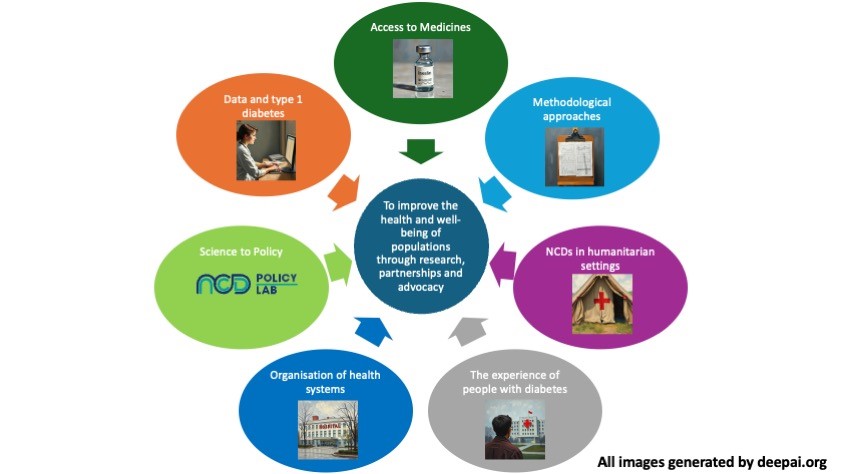
RESEARCH AIMS
Current projects include:
-
Addressing the Challenges and Constraints of Insulin Sources and Supply, conducted in collaboration with Health Action International and partners in Kyrgyzstan, Mali, Peru, and Tanzania
-
A project on access to medicines for noncommunicable diseases, with a focus on diabetes, funded by the Swiss Agency for Development and Cooperation. This project also includes a component on translating science into policy, in collaboration with colleagues in Kyrgyzstan, Mali, and Peru
-
Co-leadership of the Lancet Diabetes & Endocrinology Type 1 Diabetes Commission, funded by Breakthrough T1D and the World Diabetes Foundation
-
An implementation project in Ukraine focused on NCDs in humanitarian settings, covering policy, community engagement, health systems, and home-based care
-
A project on the management of NCDs and neglected tropical diseases in primary healthcare (Mozambique, Nepal, and Peru), funded by the Swiss National Science Foundation. This work continues through the NIHR Global Health Policy and Systems Research (Global HPSR) Programme to implement the first phase's interventions and to adapt lessons learned for the Indian context
-
A Visiting Professorship awarded to David Beran by the Danish Diabetes and Endocrine Academy to study Denmark’s data management system, with the aim of extracting lessons applicable to other settings
CORE EXPERTISE
Health system assessments; mixed methods approaches; implementation research
SELECTED PUBLICATIONS
-
Green A, Hede SM, Patterson CC, et al. Type 1 diabetes in 2017: global estimates of incident and prevalent cases in children and adults. Diabetologia. 2021;64:2741–2750. https://doi.org/10.1007/s00125-021-05571-8
-
Beran D, Lazo-Porras M, Mba CM, et al. A global perspective on the issue of access to insulin. Diabetologia. 2021;64:954–962. https://doi.org/10.1007/s00125-020-05375-2
-
Beran D, Lazo-Porras M, Cardenas MK, Chappuis F, Damasceno A, Jha N, Madede T, Lachat S, Perez Leon S, Pastrana NA, Pesantes MA, Singh SB, Sharma S, Somerville C, Suggs LS, Miranda JJ, Correia J, Govo V, Munguambe K, Munguambe S, Toyama M. Moving from formative research to co-creation of interventions: insights from a community health system project in Mozambique, Nepal and Peru. BMJ Glob Health. 2018;3:e001183. https://doi.org/10.1136/bmjgh-2018-001183
-
Zafra-Tanaka JH, del Valle A, Pastrana NA, Miranda JJ, Beran D. Patient relevant outcomes for type 1 diabetes management: a qualitative evidence synthesis. Diabet Med. 2025;42:e70016. doi:10.1111/dme.70016 https://doi.org/10.1111/dme.70016