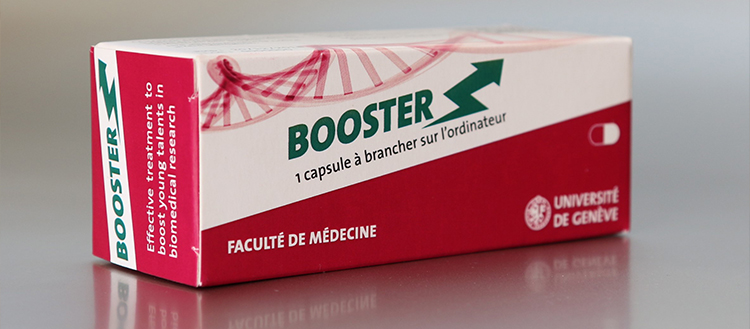
Booster 2026: Call for proposals

Take part in the 8th edition of the PhD Booster programme !
The PhD Booster is aimed at PhD students in life science who wish to deepen their skills in scientific communication and outreach, and promote their thesis project.
Participants receive personalised support to improve the presentation of their project, strengthen their ability to communicate clearly and master speaking in front of a camera.
At the end of the process, a jury of scientists and communication specialists will award four grants of CHF 5,000 each to four finalists. We will continue our fundraising efforts with the aim of offering a fifth grant.
To date, 35 PhD students in life science have won one of these grants to support their professional development.
This programme is exclusively open to PhD/MD-PhD students of the Faculty of Medicine as well as for PSLS students
- You must have completed at least 18 months of your PhD by 30 April 2026 (this rule doesn't apply to MD-PhD students) and finish your PhD no sooner than July 2027 (to have time to disburse the grant).
- You commit to respect the schedule, to prepare yourself as well as possible for the coaching sessions and torecord your video.
- Thesis projects will be presented orally in English only (during the auditions and the videos).
- You must inform your supervisor and intellectual property issues must be adressed beforehand.
Important
- You must be available to participate 1) in the auditions (in person only), 2) in the coaching sessions (online and in person) and 3) in the video shooting.
- The number of candidates is limited to 18. Therefore, only the first 18 eligible applications received will be considered.
- To apply, you must fill in the form and send a short thesis summary. The summary must be accessible to a non-scientific audience and be no longer than 250 words.
- A Q&A session will take place on 14 April CET at 11:00 am via Zoom. Your participation is not mandatory.
- Benefit from a unique opportunity to develop your skills in communication, synthesis, popularisation, etc
- Get personalised advice from a coach in scientific communication and support throughout the process
- A great learning experience and an added value on your CV, as well as a professional photography and a video presentation of your thesis project
- Receive a grant of CHF 5'000 if you are selected (4 grants currently available; fundraising underway to offer 5 grants)
Complete the online form and attach your CV and the summary of your thesis in English. The summary must be accessible to a non-scientific audience and be no longer than 250 words).
Deadline for submission of applications: 7 April 2026 (24h00 CET)
Step 1 - Auditions:
The first 18 eligible candidates will participate in the auditions, in front of a jury composed of 4 professors and 3 communication professionals. The candidates will give a 3-minute oral presentation (in English) on their thesis topic. This presentation will be assessed by the jury according to the following criteria:
- Communication, presentation and popularisation: ability to make the subject understandable to a non-expert audience
- Clarity of the objectives: ability to present and describe the objectives of the research project in a structured way
- Highlighting potential and innovation: ability to emphasise the innovative nature and potential impact of the project
- Quality and use of the PPT slides: relevance of slides (content and clarity)
- Responses to questions: ability to provide relevant and concise answers to the jury's questions
- Elocution, motivation and passion: quality of speech, enthusiasm and commitment.
Presentations must be clear, concise and accessible to a non-scientific audience. Candidates may use up to 3 PowerPoint slides (animations are permitted, but no videos) + 1 introductory slide with your name, the name of the laboratory and the title of the thesis.
Phase 2 - Coaching and video shooting:
After the auditions, each candidate will receive personalised coaching to improve their project presentations. This includes :
- Three individual sessions per candidate, focusing on improving content and presentation skills, body language and preparation for the video shooting.
- Video shooting: each candidate will present their project in front of the camera at the end of the coaching sessions. We will produce short videos of 3 minutes per candidate/project for a non-scientific audience. The videos will be published on the Faculty of Medicine website, as well as on UNIGE's social media.
Phase 3 - Selection of the finalists:
The jury will gather again to watch the videos of the presentations and make a new assessment based on the following criteria:
- Communication, presentation and popularisation: ability to make the subject understandable to a non-expert audience
- Relevance of the PPT slides: quality, clarity and coherence of slides
- Fluency and rhetoric: articulation, art of speech and quality of argument
- Elocution and commitment: clarity of speech, motivation and passion
- Respect of the presentation time : presentation within the time limit
This process aims to select 4 finalists (5 finalists if additional funding is available). The selected PhD students will receive a grant of CHF 5'000 each to be used, for example, to participate in international meetings, to follow training courses, to visit laboratories abroad, or to cover the printing costs of their thesis.
Weight of the final assessment :
- Video presentations: 75%
- Auditions: 25%
-
April 7 – Registration deadline
-
April 21 and 23 – Auditions
Candidates will present their project and be interviewed (20 minutes each) on either April 21 or April 23 -
May 5 and 6 – First coaching session (in-person or via Zoom, 30 minutes per candidate)
Focus on the content of the presentation. -
May 21 and 22 – Second coaching session (online, 30 minutes per candidate)
Focus on the structure and slides of the presentation -
June 3 and 4 – Third coaching session (in-person, 30 minutes per candidate)
Focus on presentation delivery (non-verbal communication, body language, tone of voice, etc.) -
June 15–17 (dates to be confirmed) – Video shooting (1 hour per candidate)
-
Mid/end of June– Editing, production, and publication of the videos
-
Early July – Selection of the finalists
-
From August onward – Follow-up on the use of stipends with the finalists