
NCCR Evolving Language

The National Centre of Competence in Research (NCCR) Evolving Language is a national, interdisciplinary research consortium that brings together research groups from the humanities, computer science, social sciences and natural sciences to solve one of humanity's greatest mysteries: what is language? How did our species develop this ability to express itself, process language and constantly pass on new linguistic variations to new generations? How will our language capacity change with the arrival of new media and neuroengineering? Hosted by the UNIGE Faculty of Medicine, the NCCR Evolving Language is committed to applying fundamental research to society.
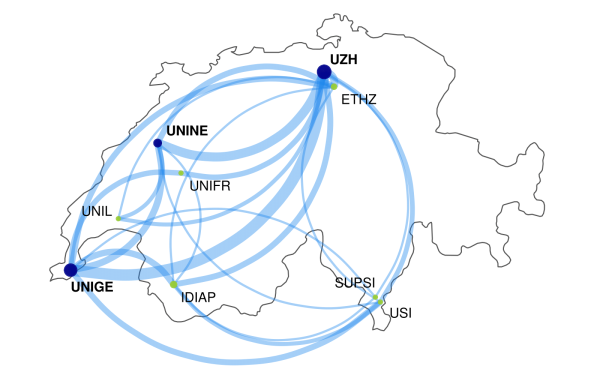
A national and transdisciplinary network
The NCCR Evolving Language is based on a transdisciplinary approach that brings together 40 groups with a broad range of expertise from the country's leading academic institutions, and is co-directed by the universities of Geneva, Zurich and Neuchâtel. Specialists in linguistics, psychology, neuroscience, biology, anthropology, medicine, genetics, computer science, geography, mathematics and philosophy work on all aspects of language, communication and cognition in humans and animals, particularly in our closest relatives, the great apes.
The research teams work notably on:
- the neural and computational processes involved in speech processing and planning, as well as the opportunities and risks of applied neurotechnology
- how children learn their language within very different traditional cultural environments, from the Amazon to the Himalayas
- the processes of diversification and variations in language, as well as the influence of machines on our communication and our way of thinking.
At UNIGE, research on the human brain
At the University of Geneva, a pioneer in neuroscience, research groups explore the human brain and its mechanisms for producing, processing and learning languages. Using cutting-edge technologies such as magnetoencephalography (MEG), sleep studies and neurostimulation, they enhance both the understanding of language evolution and the treatment of language disorders.