
How tumours locally shut down the immune system
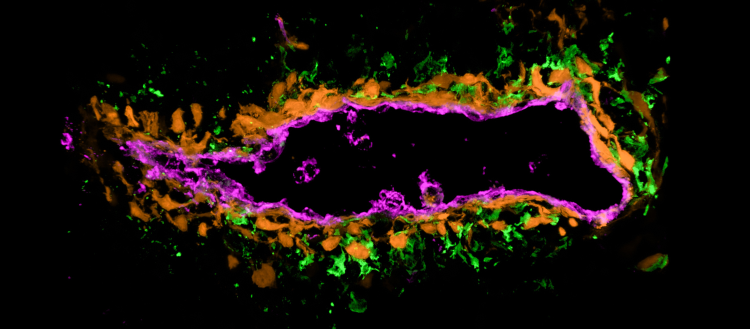
Image : F. Duval, UNIGE. Immune hubs within tumors can either strengthen the body’s antitumor response or silently dampen it. These structures form in close proximity to blood vessels (pink, endothelial cells; orange, pericytes) and contain dendritic cells (green), which can either activate or suppress antitumor immunity.
In a new study published in Immunity, a research team from the Department of Pathology and Immunology and the Translational Research Centre in Onco-Haematology (CRTOH) at the UNIGE Faculty of Medicine uncovers how cancers create small, highly organized “immune hubs” that can either help the body fight tumours or quietly switch those defences off.
The research team, led by Mikaël J. Pittet, found that specialized immune cells called dendritic cells gather around blood vessels inside tumours. In these locations, they are well positioned to activate T cells, the immune system’s main cancer-fighting force. These perivascular hubs resemble miniature command centres where immune responses can be launched directly inside the tumour.
“We were struck by how consistently these dendritic cells position themselves next to blood vessels,” said Beatrice Zitti, first author of the study. “These sites seem ideal for coordinating immune responses, but we found that they are also where immune suppression is most actively enforced.”
The study reveals that regulatory T cells, which normally help prevent harmful immune overreactions, closely interact with dendritic cells within these hubs. There, they suppress key activation signals, effectively dampening the local immune response against cancer. “Regulatory T cells are not randomly distributed in tumours,” Zitti explained. “They actively engage dendritic cells in these hubs and shut down their ability to fully activate T cells, even though all the ingredients for an immune attack are present.”
The researchers also discovered how these immune hubs form in the first place. Signals released by cells surrounding tumour blood vessels guide dendritic cells into position, organizing them into stable clusters. “Blood vessels are not just conduits for nutrients and oxygen,” said Florent Duval, co-first author of the study. “They provide spatial cues that structure the immune landscape of the tumour, effectively shaping where and how immune cells interact.”
Gaining a better understanding of why some immunotherapies fail
Importantly, the study helps explain why immunotherapies such as anti-PD-1 do not always produce durable responses. While these treatments enhance immune activation within the hubs, they can also strengthen the local suppressive interactions that restrain dendritic cells.
“Our findings show that tumours exploit very local immune checkpoints that standard immunotherapies do not fully address,” said Mikael J. Pittet, senior author of the study.
To make immunotherapy more effective, we need to think about releasing immune cells from the suppressive microenvironments that tumours create.
By identifying the molecular and spatial mechanisms that organize and restrain these immune hubs, the study opens the door to new treatment strategies aimed at strengthening local anti-tumour immunity while selectively lifting immune suppression.
19 Dec 2025