
Blocking inflammation to treat metabolic liver diseases
Metabolic liver diseases (MASLD and MASH) now affect a growing proportion of the global population. Often silent in their early stages, they can progress to serious forms such as fibrosis or cancer. While fat accumulation marks the starting point, chronic inflammation acts as the driving force behind the progression. Targeting inflammatory mechanisms therefore appears to be a promising strategy for slowing the progression of metabolic liver diseases.
Reducing inflammation to slow disease progression
In patients with metabolic liver diseases, interleukin-18 is elevated, as its binding protein IL-18BP, which neutralises its pro-inflammatory activity. In their recent article published in Hepatology Communications, scientists from Prof. Jornayvaz's laboratory sought to better understand the role of IL-18BP in disease progression. Using mouse models (in collaboration with Prof. Cem Gabay), the research team was able to demonstrate that it has a protective effect on the liver by limiting inflammation induced by a high-fat diet.
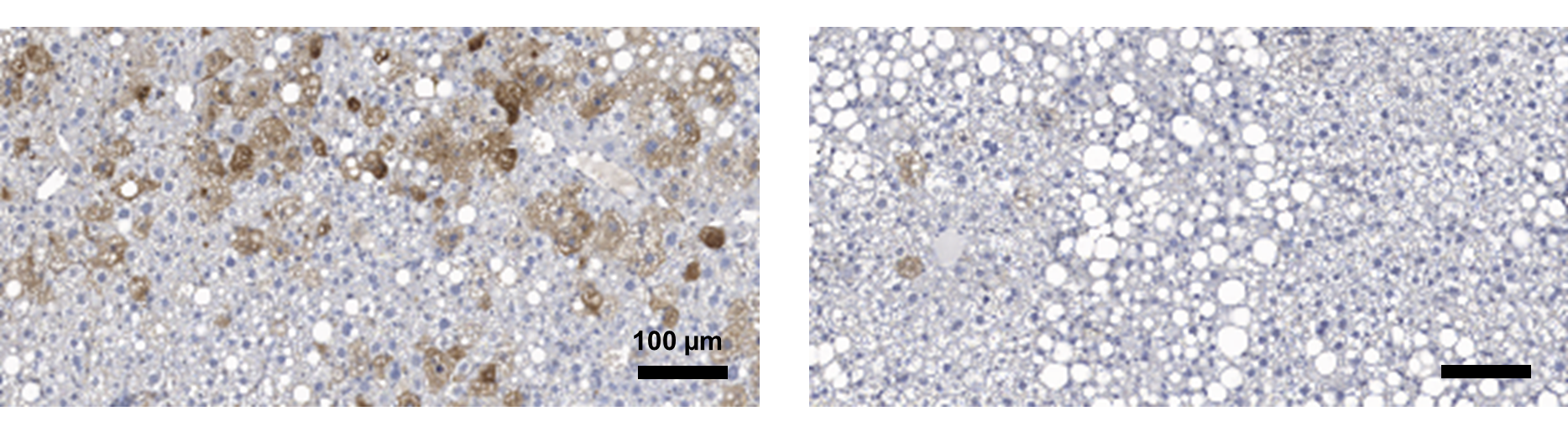
The absence of the IL-18BP binding protein causes inflammation, visible in brown in the image on the left, compared to healthy individuals (image on the right). © Adapted from Figure 2 in Somm et al. 2025 Hepatol Commun.
And beyond the liver?
IL-18 and its binding protein IL-18BP do not only act in the liver, but also in other organs, such as the intestine. In order to discover the mechanisms at work, scientists at UNIGE, in collaboration with Prof. Jacques Schrenzel's team at the HUG, studied the intestinal microbiota of mice lacking IL-18BP. Their findings, published in the journal JHEP Reports, show that IL-18BP limits the progression of liver disorders by acting on the gut microbiota. The absence of IL-18BP in the gut reduces the gut's anti-bacterial defences and increases the abundance of certain harmful bacteria that contribute to liver inflammation.
Future implications
By specifically neutralising IL-18, IL-18BP could attenuate the inflammatory cascade and reduce the dysfunctions associated with metabolic liver diseases. This approach opens up new therapeutic prospects for limiting the progression to fibrosis and liver cancer.