
A firefly that inspires greener nanotechnology
Nanocoatings are ultra-thin surface layers, often thousands of times thinner than a human hair. They are widely used in industry to enhance optical, mechanical, and chemical performance. However, their production requires energy-intensive processes and environmentally unfriendly chemicals, thus prompting a growing search for more sustainable production methods.
A firefly with antireflective and anti-adhesive nanocoatings
By screening nanostructures across many beetle genera, researchers from the laboratory of Prof. Vladimir Katanev identified Luciola lusitanica as a unique case: its body surface carries specific nanocoatings that are both antireflective and anti-adhesive, and that improve transparency and enhance the efficiency of its bioluminescent signals.
The results, published in the journal EMBO Reports, show that the firefly’s nanocoatings form through a delicate protein–lipid self-assembly which is highly sensitive to temperature. Small thermal changes can destabilise the structure, preventing the coating from forming. This sensitivity not only limits where the species can live, but also suggests that complex, functional nanostructures can emerge, and disappear, simply by adjusting environmental conditions.
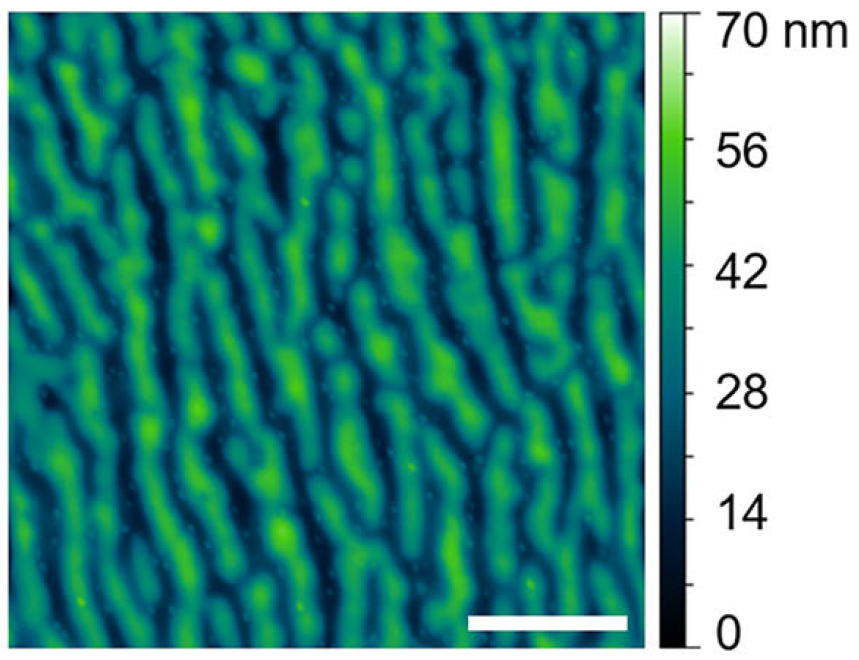
Microscopy image (on the left) of the nanocoatings covering the abdomen of the firefly Luciola lusitanica (adapted from Figure 1 in Kryuchkov et al. 2026 EMBO Reports) and simulation of nanocoating formation (on the right). The lighter the color, the taller the protuberances.
What nature teaches us here is not just how to make nanocoatings, but how to control them.
From glowing insects to greener technologies
The study on fireflies opens the door to many applications. It could lead to more environmentally friendly ways to produce nanocoatings and guide the design of materials whose assembly can be precisely controlled. In the long term, this nature-inspired approach could make it possible to activate, adjust or even erase nanocoatings using external signals such as light or lasers.